Seven Years of Piecing Together Hangzhou
Contents
Hangzhou: 100% Explored
The scent of osmanthus was fading from the city, a sign that Jiangnan’s cold, wet, overcast winter was on its way. Before the golden days of October ended, I visited the last few parts of Hangzhou I had yet to set foot in. “Corners” makes them sound more mysterious than they were: they were simply townships, towns, and neighborhoods on the administrative map. Driving or walking through one was enough to mark it as visited.
At some point, Amap introduced a feature called “Travel Footprints.” I stumbled across it the month before and discovered that I had only a few places left to unlock, nearly all of them in Qiantang District, around Dajiangdong. So, on a clear day, I set off by car to fill in the final gaps and complete my exploration of all 253 corners of Hangzhou.
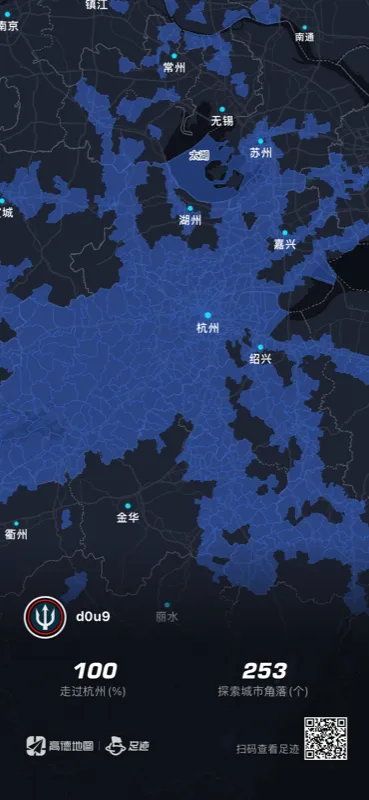
“Travel Footprints” in Amap.
First Impressions of Hangzhou
I first saw the beauty of Hangzhou on 18 November 2015. An overnight journey in a sleeper carriage on the express train from Beijing brought me to Hangzhou Railway Station the next morning. Swept out of the station by the crowd, I felt a thrill at my first sight of the city. The sky was overcast that day, much like today. The clouds hung low and a light drizzle fell—the sort of cold, damp Jiangnan winter weather that brings on a vague sense of melancholy.
I had never carried an umbrella when I went out in Beijing. The moment I stepped outside the station, I learned what the fine, persistent mist of Jiangnan could do. It drifted down almost weightlessly, but soon soaked through my clothes. I struggled on through the rain for a while before giving in and dashing into a Carrefour to buy an umbrella. It was not a Tiantang, Hangzhou’s famous local brand, but a Xihu. The quality was nothing special, though it did the job. That Carrefour closed for good this year, which is a shame.
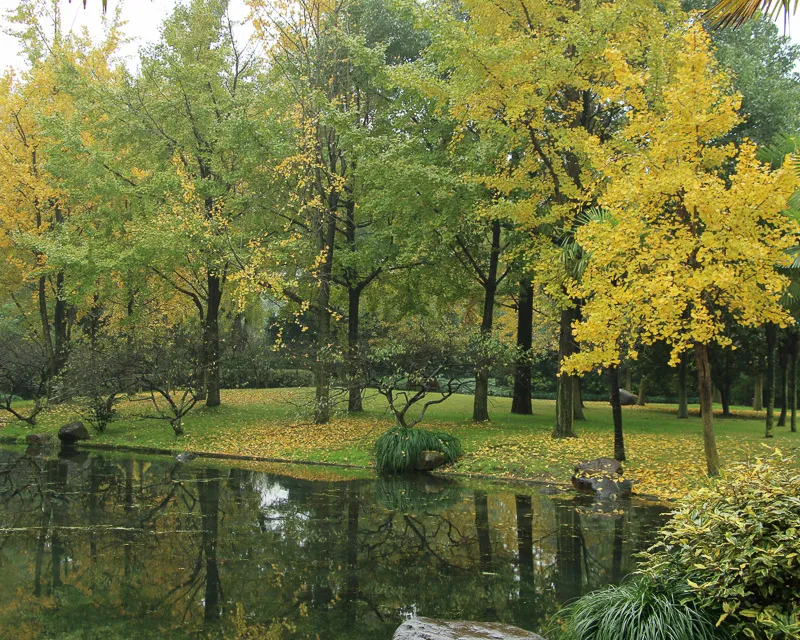
One of the first photographs I took around West Lake. By November, the ginkgo trees along the shore had turned yellow.
Canon EOS 70D; EF-S 18-135mm f/3.5-5.6
24mm; 1/40 sec; f/6.3; ISO 160
2015-11-18
A broad, straight road called West Lake Avenue links Hangzhou Railway Station with the lake. Follow it west and you arrive at Yongjin Gate. Standing by the water under my umbrella, I could not help thinking how beautiful Hangzhou was. There is a local saying: “West Lake in sunshine is not as beautiful as West Lake in rain, and West Lake in rain is not as beautiful as West Lake in snow.” The lake in rain and mist was surpassed only by the sight of West Lake covered in snow beneath a clear sky. The distant hills appeared and disappeared through the mist, making the scene feel otherworldly.
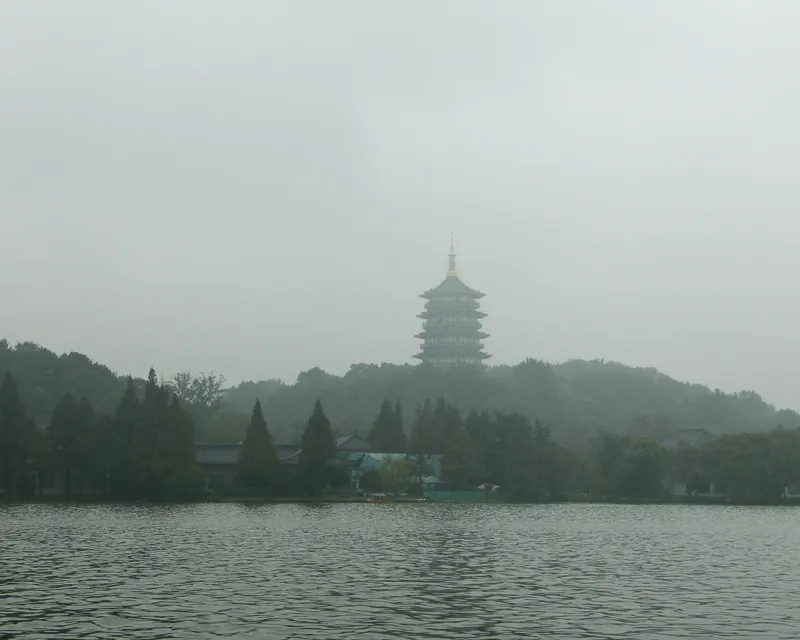
My first photograph of Leifeng Pagoda at West Lake. The original was in color; I later converted it to black and white.
Canon EOS 70D; EF-S 18-135mm f/3.5-5.6
35mm; 1/400 sec; f/7.1; ISO 160
2015-11-18
I spent my first night in Hangzhou at a hotel near Long Bridge on West Lake, not far from Wansongling Road. That modest hotel has since closed as well. Falling asleep in November with the window open and the rain tapping outside felt strangely wonderful. It was my first impression of a Hangzhou night. Having lived in northern China for years, I associated November with bare landscapes and bitter cold. Here in the south, everything was still alive and green.

College of Computer Science and Technology, Zhejiang University; Yuquan Campus.
2015-11-19
That first excitement was soon washed away by the endless rain the following day. I had come to Hangzhou for two reasons: a job interview and a meeting with a prospective doctoral supervisor. A little after five in the afternoon, as I walked along a path on Zhejiang University’s Yuquan Campus, it was already nearly dark. Towering plane trees blocked out what little light remained. The sparse street lamps cast a dim yellow glow, further weakened by the damp mist. Shadowy figures on the paths, together with the campus ghost stories I had heard, gave the whole place an eerie air.
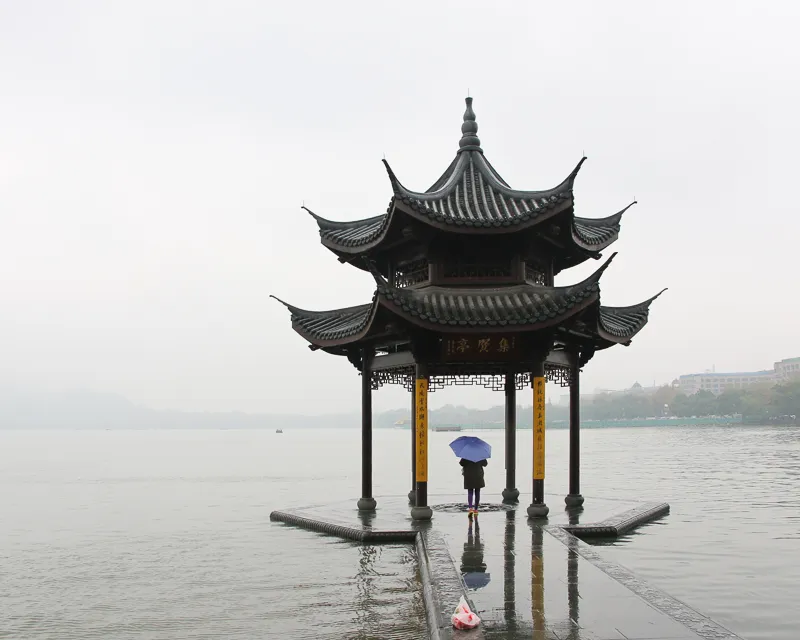
Jixian Pavilion by West Lake.
Canon EOS 70D; EF-S 18-135mm f/3.5-5.6
18mm; 1/60 sec; f/6.3; ISO 200
2015-11-20
After leaving the Yuquan Campus, I waited for a bus beside Tianmushan Road. Four rows of tall camphor trees broke the street lamps’ light into patches across the ground. I began to wonder whether all of Hangzhou was like this—dark, wet and dripping. It is funny to think back on it now, but at the time I half believed that Yuquan Campus stood on the edge of the city. In my mind, only the outskirts of a city could feel that way.
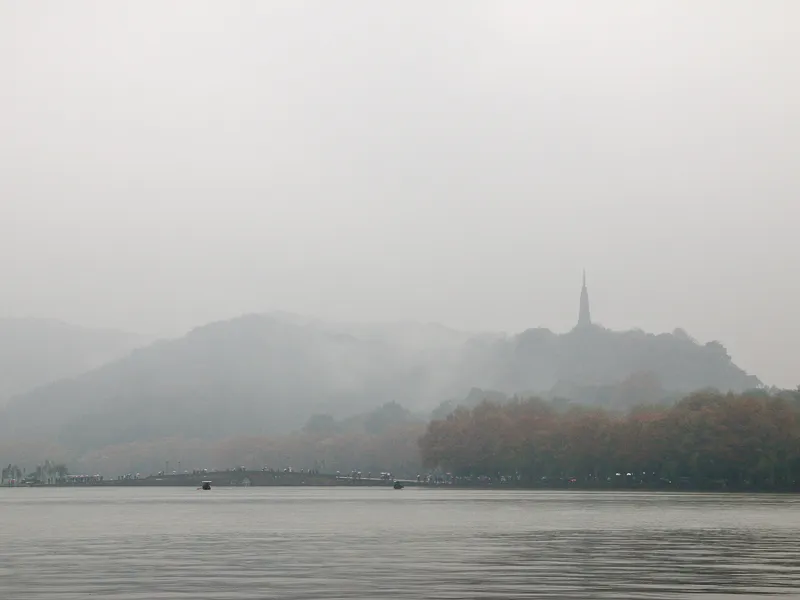
Broken Bridge and Baochu Pagoda in the rain. Baochu is pronounced “Bao-choo.”
The solid stone pagoda stands at the summit of Precious Stone Hill, facing Leifeng Pagoda across the lake.
Canon EOS 70D; EF-S 18-135mm f/3.5-5.6
50mm; 1/125 sec; f/7.1; ISO 200
2015-11-20
I spent the final day of the trip making my way around West Lake. Once I had seen the sights, my first visit to Hangzhou came to an end. I can still clearly remember taking the No. 7 bus from the Botanical Garden to Hangzhou Railway Station. The crowded bus emptied almost completely after it passed Broken Bridge.
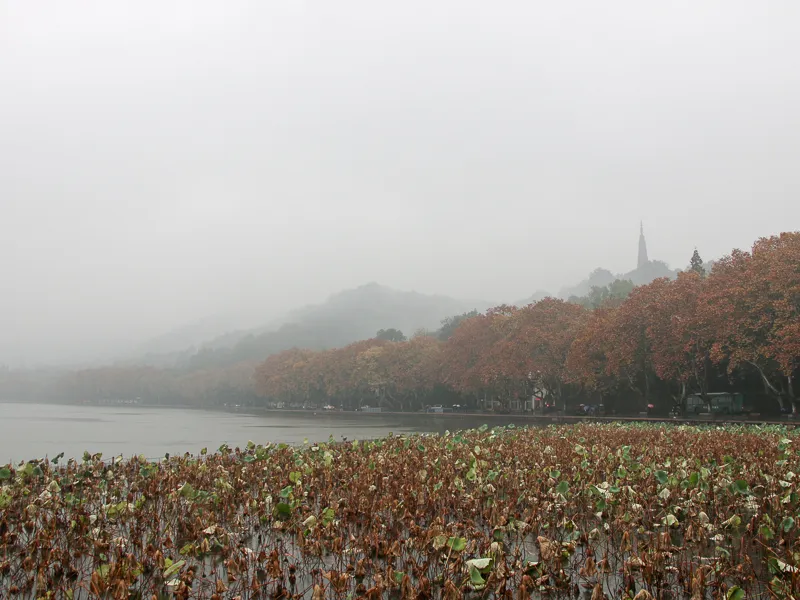
Withered lotus on West Lake, the plane trees of Beishan Road and Baochu Pagoda.
Beishan Road runs below Precious Stone Hill beside Broken Bridge and is lined with historic buildings.
Canon EOS 70D; EF-S 18-135mm f/3.5-5.6
50mm; 1/125 sec; f/7.1; ISO 200
2015-11-20
Placing the Final Piece
Of the last few pieces in my Hangzhou puzzle, the most memorable was Yushan Township. From this corner of Fuyang, a narrow road leads across the hills into Xiaoshan. Another route loops back toward Lishan Town, also in Fuyang.
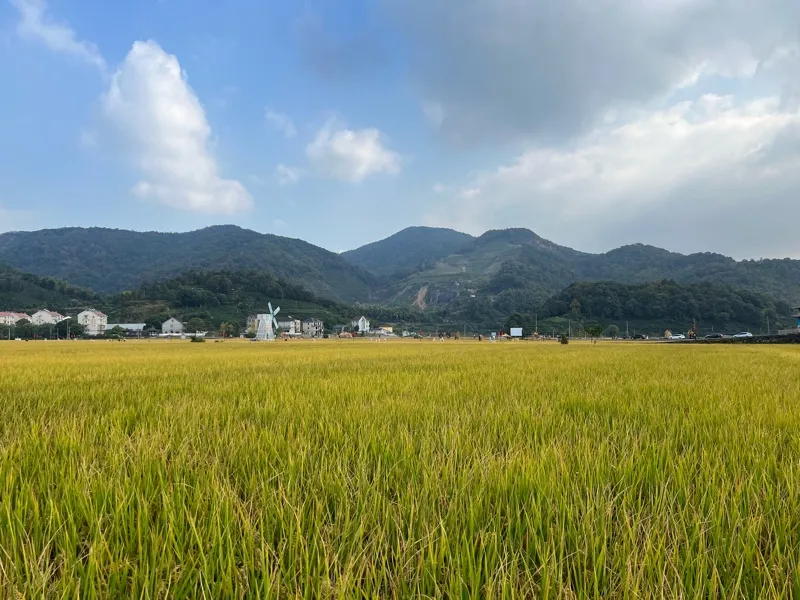
Rice fields in Fuyang, Hangzhou.
iPhone 13 Pro
2022-10-29
We passed through Yushan just as the autumn rice harvest was under way. The scent of rice mingled with the smell of grass and drifted toward us—the smell of harvest. After a single circuit of the field, the combine had turned standing rice into several sacks of unhusked grain. People from the city had driven out to buy it directly from the farmers. They stood at the edge of the field, watching expectantly.
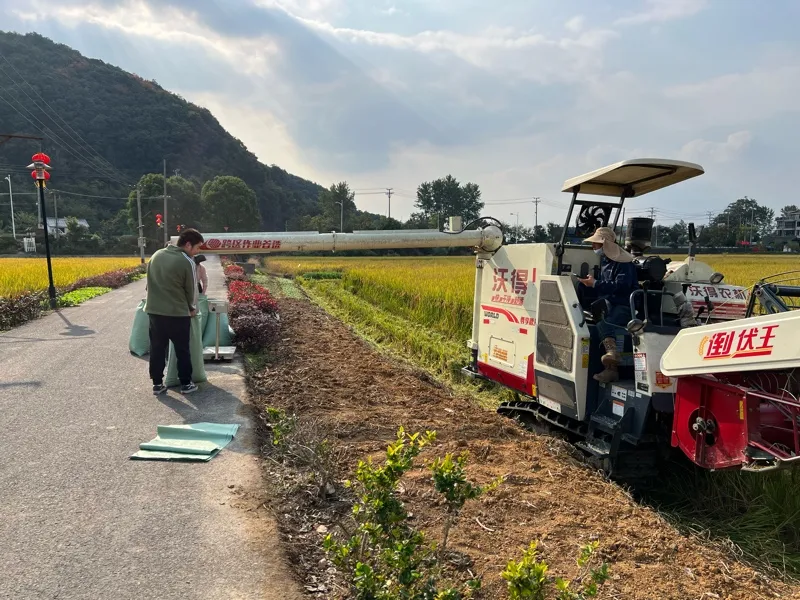
People who had driven from the city to buy freshly harvested rice. In little more than ten minutes, the combine filled several sacks with grain.
iPhone 13 Pro
2022-10-29
I like standing in a field and watching the harvest. The blue sky, the golden rice, the fragrance in the air, and the roar of the combine breaking an otherwise deep stillness—it all puts me at ease.
After enjoying the quiet, we followed the road through the countryside until the straight road gave way to mountain bends. The broad asphalt climbed quickly, and before long the whole of Yushan Township lay below us. Several roads met at the summit. One led toward Xiangtianling Reservoir in Xiaoshan, but this time I chose the route that looped back to Lishan Town in Fuyang.
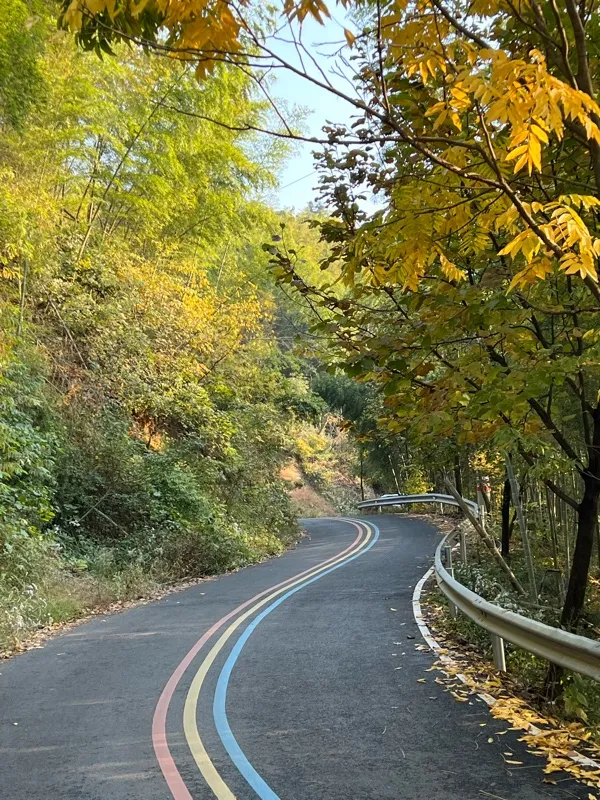
At the summit on the boundary between Fuyang and Xiaoshan. The roads are generally good, the autumn colors are rich, and it is a pleasant place for a relaxing drive.
iPhone 13 Pro
2022-10-29
The road along the ridge was winding and a little worn. Groups of motorcyclists swept through the mountains, looking entirely at ease. To my surprise, the farther we went, the more visitors we encountered. Where private cars lined both sides of the road, we found a lookout. We parked and continued on foot, only then realizing that this was Anding Mountain, a well-known camping spot on Hangzhou’s social-media circuit.
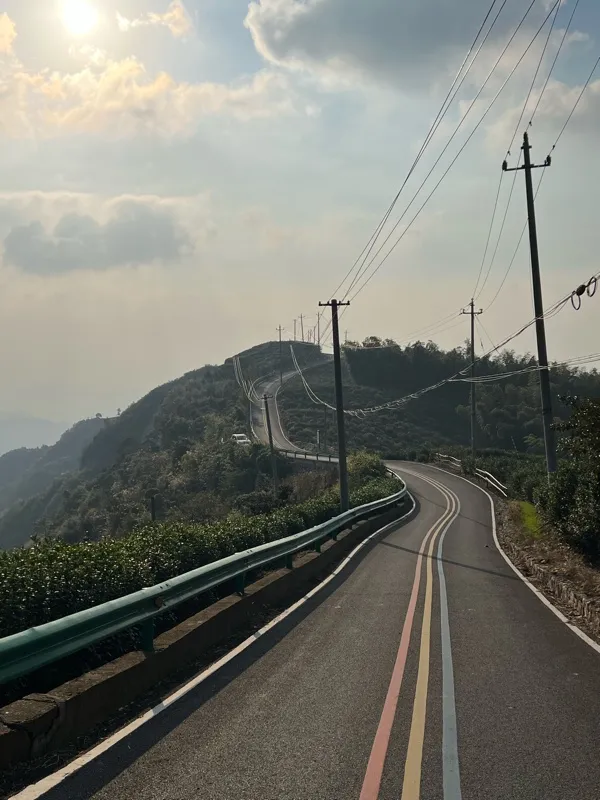
The ridge road offers an open view and is popular with groups of motorcyclists.
iPhone 13 Pro
2022-10-29
I tend to avoid crowds, especially at so-called internet-famous places. But since we had found ourselves there, we stayed at the lookout to watch the sun go down. The sunset set the sky ablaze and turned the mountains blue-black. Ridge after ridge shifted from red in the distance to deep green nearby. On the far horizon, the Fuchun River caught the sunlight and glittered. Even from a great distance, it was impossible to overlook.
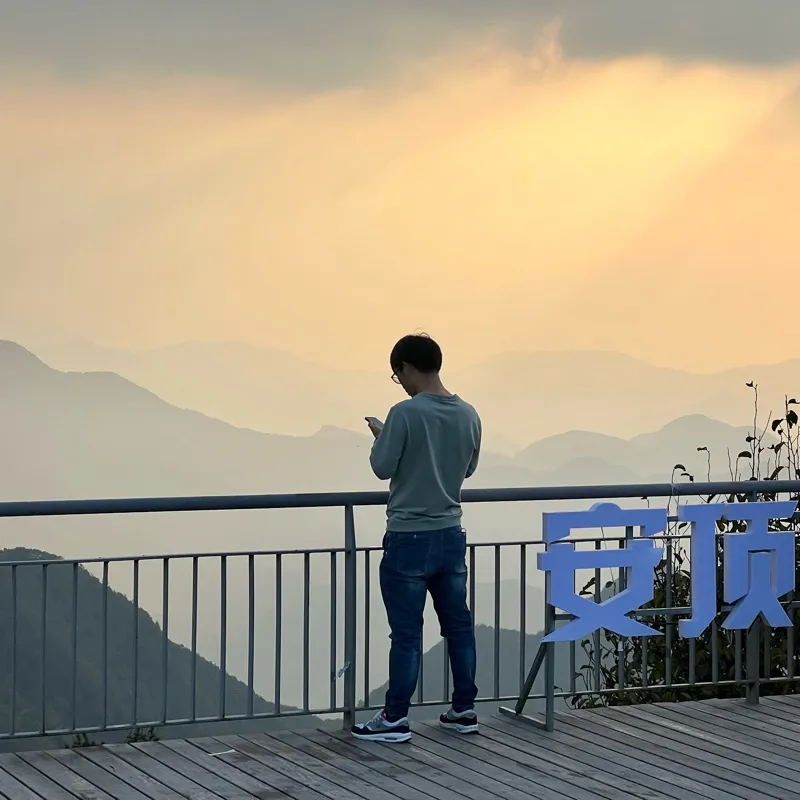
The lookout on Anding Mountain, with a sweeping view of the Fuchun hills.
iPhone 13 Pro
2022-10-29
The Fuchun River inevitably brings to mind Dwelling in the Fuchun Mountains, the celebrated scroll by the Yuan-dynasty painter Huang Gongwang. The scene before me was not exactly the one he painted, of course, but it carried something of the same spirit.
The sunset burned bright; the mountains rested in silence. Life holds many autumns, and a smile can scatter a hundred sorrows.
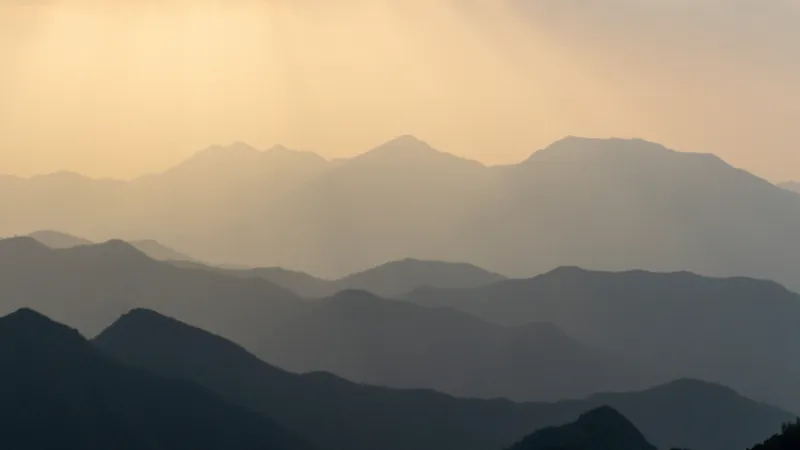
The blue-black Fuchun hills.
iPhone 13 Pro
2022-10-29
· END ·
2022-11-01