Duolunduo, a Hidden Paradise
Contents
Hundreds of millions of years of geological change have given Nangqên rich mineral resources and created the ancient salt fields of Duolunduo. The traditional salt-making techniques preserved to this day are the best tribute to this gift from nature.
Returning to Duolunduo
At seven in the morning, Nangqên County was still asleep. Finding somewhere for breakfast at that hour was difficult, so we made do with a few flatbreads and pickles before setting off toward Duolunduo once again. The morning clouds gradually dispersed as the sun rose, revealing a deep blue sky. It was going to be a fine day.
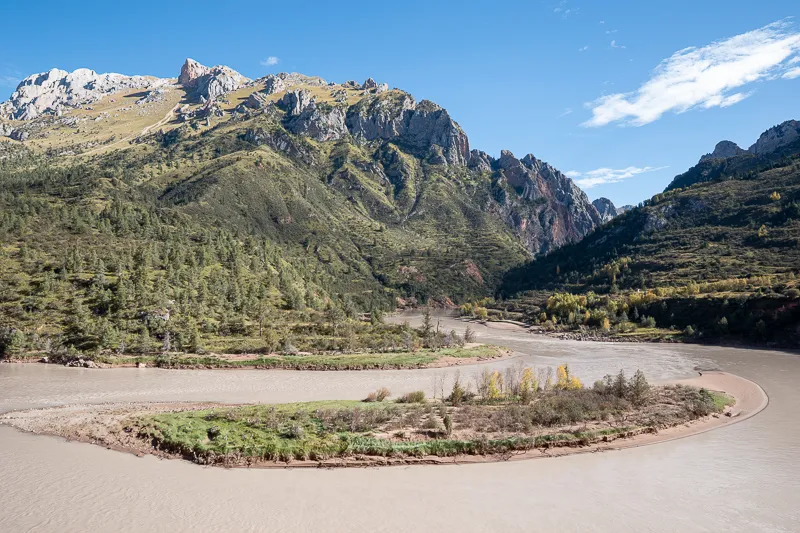
Mountains everywhere on the road to Niangla Township
Canon EOS 6D
EF 24-70 f/2.8L II USM
F10 | 1/80 s | 24mm | ISO 100
The sunlight finally revealed the canyon in full. While admiring its unusual landscape, we also wanted to capture some of its wild scenery with the camera. Stopping in the canyon was clearly risky. After finding a relatively open spot, I jumped out of the car with the camera, intending to take a few quick photographs and leave.
At that moment, a young Tibetan man stopped his motorcycle beside the road and came over curiously. In hesitant Mandarin, he also reminded us that rocks often fell here and that we should be careful. After taking a few photographs, we quickly got back into the car and left the dangerous spot. The young man climbed back onto his motorcycle and bounced along the uneven road ahead of us.
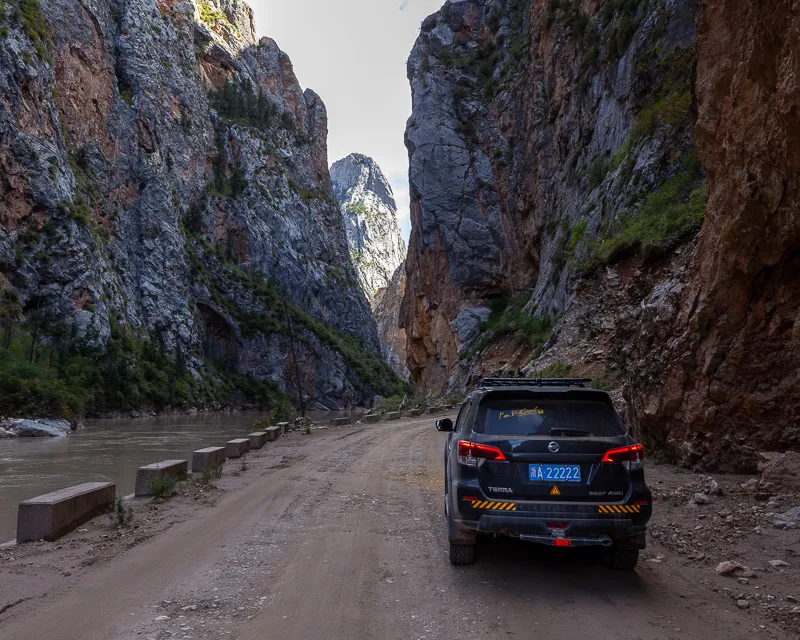
The canyon near Niangla Township
Canon EOS 6D
EF 16-35 f/2.8L III USM
F9 | 1/30 s | 24mm | ISO 160
On roads like this, motorcycles have far better access than cars. After a few bends, he disappeared from view. Not long afterwards, though, we met again, this time because he was waiting for us beside the road. Across from where he had stopped was a huge rock face, with Buddhist figures and Tibetan script carved into it and shining gold in the sunlight. Pointing at the carvings and gesturing with his hands, he said, “This, I carved! There’s another one being carved inside.” Carving into a nearly vertical cliff with simple tools was clearly difficult work. I looked back at his proud expression and gave him a thumbs-up.
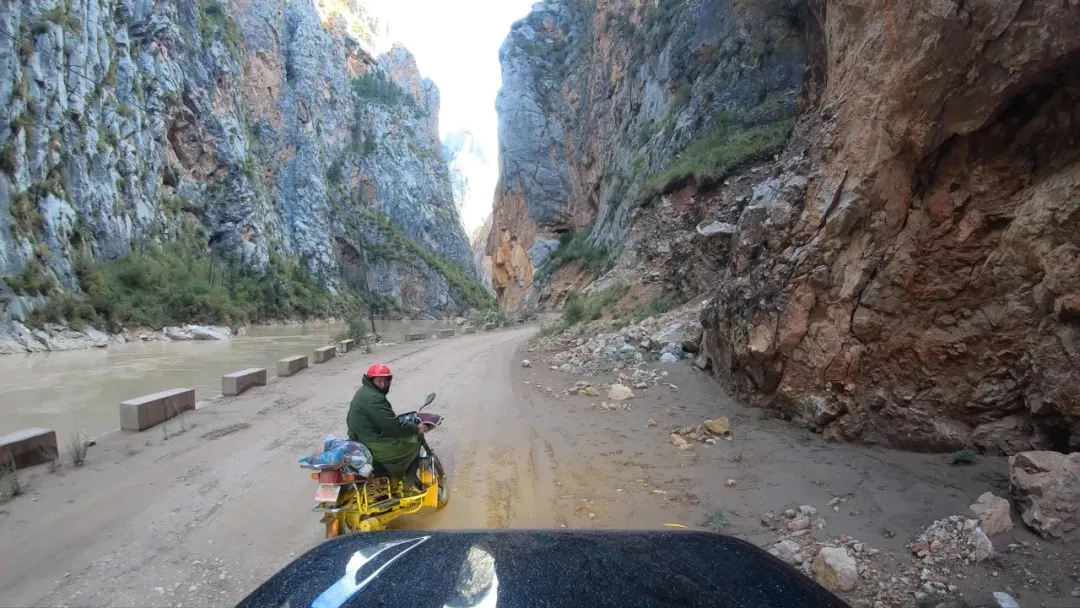
The young Tibetan man who warned us about falling rocks
Gopro 7
On the other side of the road was a large pile of stones, built by stacking smaller stones on top of larger ones. When I asked what it was for, the young man put his palms together and said, “This is for Amitabha.” I did not know the exact name of the stone pile, but its meaning was simple enough to understand.
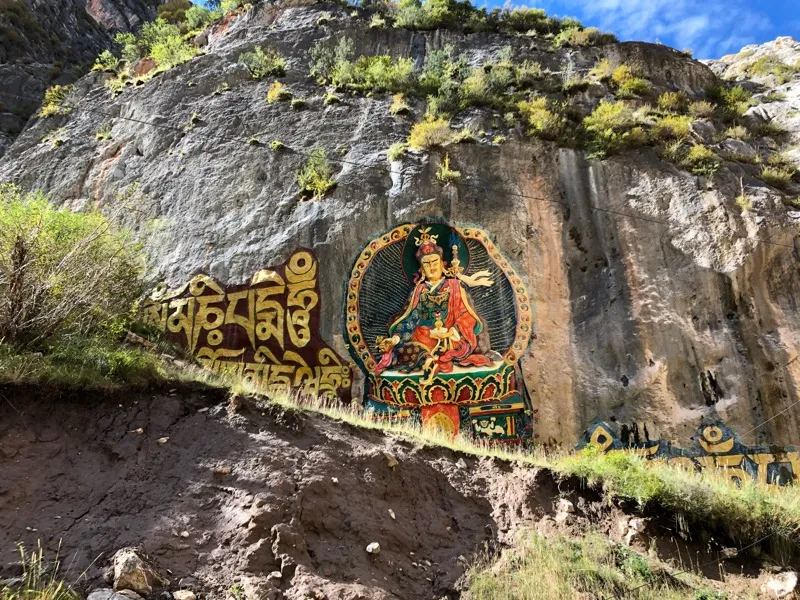
The young Tibetan man’s work, Buddhist figures and Tibetan script carved into the rock face. Another figure was still being carved among the trees on the left side of the photograph.
iPhone8
Once out of the canyon, Niangla Township was not far away. It was very small, more like a village than a township, and it took only a few minutes to drive along all of its roads. One thing worth mentioning was the school, which was beautifully built and probably the best building in the entire township.
The Drone Crash
The road from Niangla Township to Duolunduo was a winding dirt road through the mountains and was not particularly difficult. The truck that had broken down the previous evening was still sitting in the same place, looking rather lonely. Near the top of the mountain, the terrain opened up and the scenery was excellent, making it a perfect place for aerial photography. The flight itself went smoothly, but during landing the drone touched down at an abnormal speed and one of its propeller arms snapped. Even with one arm broken, it struggled back into the air. The unbalanced propeller struck the body with a series of sharp noises. It managed to stay up for a while before falling to the ground again, yet the propellers kept turning as though it still wanted to take off.
I had crashed the drone. It was my first crash, and it happened in a way I had never imagined. After collecting the wreckage, I felt strangely lost. The salt fields near Niangla Township had long been one of the places I most wanted to photograph from the air, yet just before reaching them, I had lost the drone. I stood blankly on the hillside, discouraged and unsure what to do.
The crash put me in such a bad mood that I no longer felt like looking at the scenery. It felt almost like suddenly having to say goodbye to a friend who had been with me for a long time. With that feeling, we did not stop again and drove straight to Duolunduo Village.
The Healing Power of Duolunduo
Continuing north after passing through Duolunduo Village, we soon saw the ancient salt fields arranged in layers like terraces. Each level consisted of small pools used to evaporate brine and produce salt. October was already past the rainy season, so the salt fields were dry, but they were still impressive.
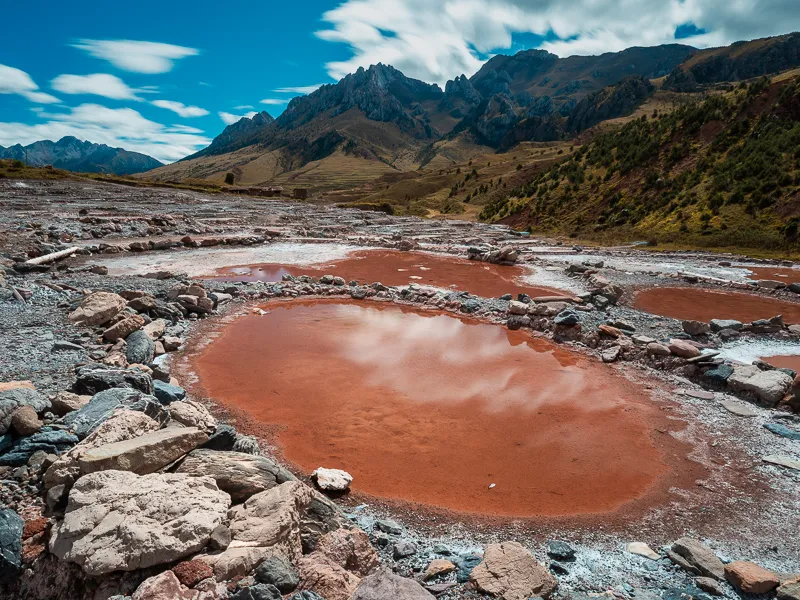
Ancient salt fields of Niangla Township
Canon EOS 6D
EF 16-35 f/2.8L III USM
LEE ND filter, LEE Polarizer
F20 | 30 s | 20mm | ISO 100
The salt fields of Duolunduo are still in use today, supplying salt for local residents and herders in the surrounding area. Salt-making has been an important livelihood for generations of villagers, with the old techniques passed down from one generation to the next. During spring and summer, when there is plenty of water, brine from the salt springs is channelled into prepared salt pools and allowed to evaporate naturally under the strong sunlight. The remaining salt crystals are then collected, stored in warehouses and sold elsewhere. Because the process remains simple and traditional, without industrial contamination, the salt is well liked by local people.
Standing below the ancient salt fields, I still had not shaken off the disappointment from the drone crash. I walked empty-handed for a while along the paths between the pools and sat on a stone beside one of them, staring at the distant mountains and watching tractors move up and down between the salt fields carrying fodder. I realized that I should not let myself miss this secluded place.
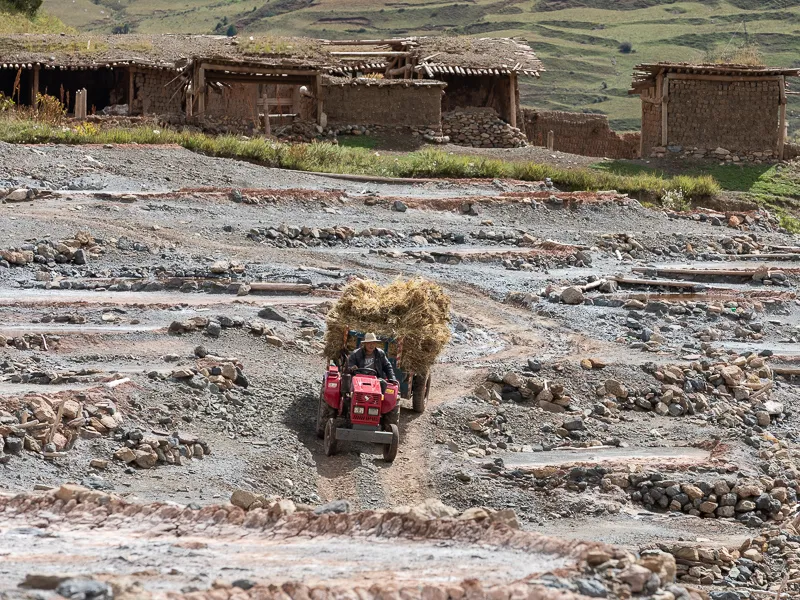
A tractor moving through the salt fields
Canon EOS 5D Mark IV
EF 70-200 f/2.8L IS III USM
F6.3 | 1/400 s | 200mm | ISO 100
I went back to the car for the camera and returned to the higher salt fields. After taking this photograph, I finally began to relax. Looking at the people working in the distance and the children playing, at the blue sky and green grass, and at the family dog sleeping in the shade beside our car, what could have been more calming than this? A light breeze moved through the quiet valley, rustling the grass. The sounds of work mixed with birdsong, making Duolunduo seem even quieter and more peaceful. The tension gradually disappeared. Perhaps this was Duolunduo’s way of healing.
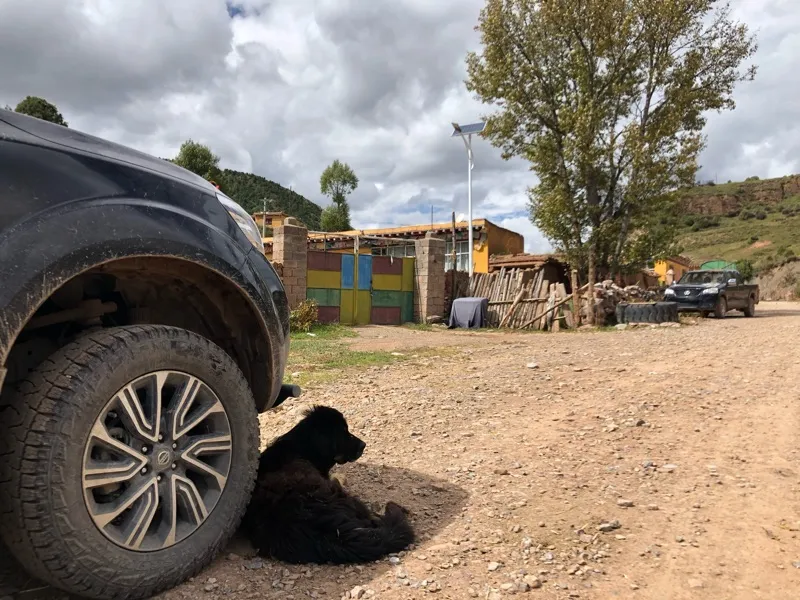
A dog sleeping in the shade beside our car.
iPhone 8
A Hillside of Purple Gentians
However reluctant I was to leave, it was time to go. Before today, I had spent much of the trip trying to keep up with the plan and had missed many places where it would have been worth stopping for a while. When all you can see is the destination, you stop noticing what is along the way. Travel loses its meaning and turns into a race.
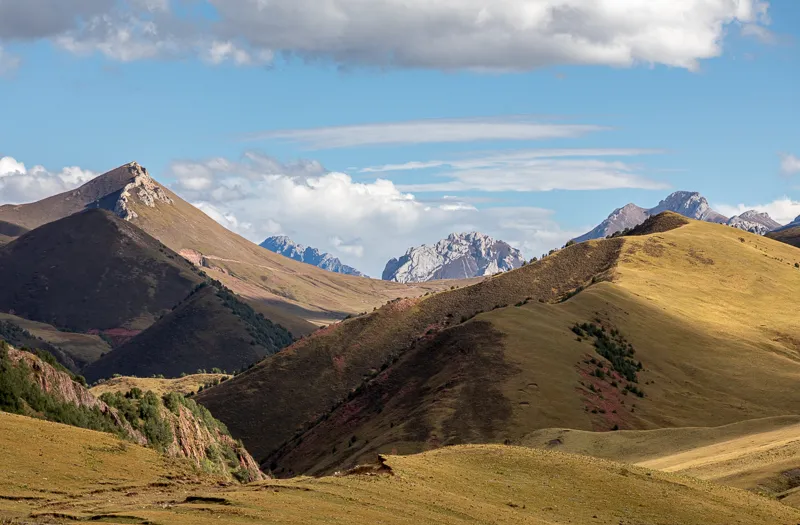
Clouds casting huge shadows across the mountain
Canon EOS 5D Mark IV
EF 70-200 f/2.8L IS III USM + 2X III
F8 | 1/500 s | 155mm | ISO 250
After saying goodbye to Duolunduo, we set off again. This time, the destination had changed from Zadoi County to Yushu City. I gave up on Angsai Grand Canyon and Hoh Xil because I wanted to travel more slowly and look more carefully. Without the pressure of rushing from place to place, I felt much more relaxed and began to enjoy the scenery along the road. We chose a new route we had not taken before, which would take us directly to Gading Monastery, then through Xialaxiu Town and back to Yushu City.
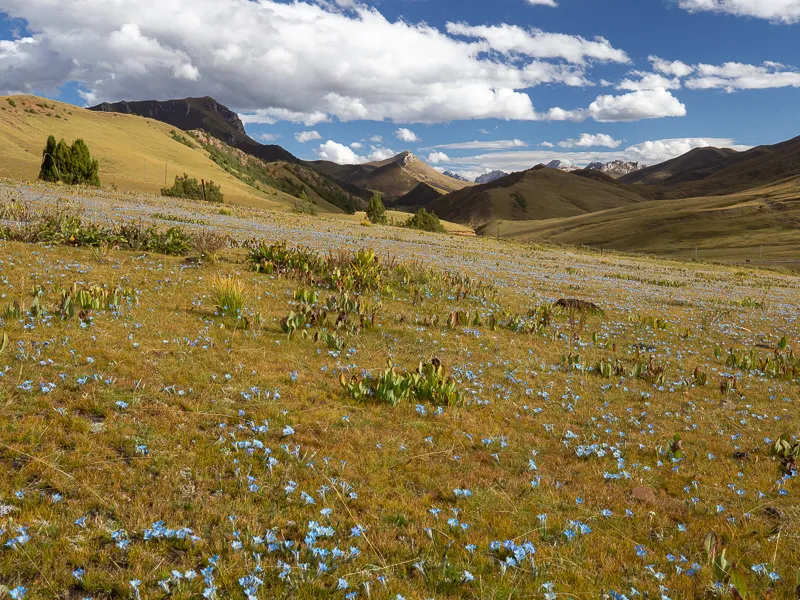
A hillside covered in purple gentians
Canon EOS 6D
EF 16-35 f/2.8L III USM
F20 | 1/50 s | 24mm | ISO 160
The road stretched between gentle hills, with no steep canyons, only distant mountains and grass covering the valleys. On this bright afternoon, I began to feel sleepy. Whenever tiredness comes while driving, I usually find somewhere to stop and sleep. I parked in an open area and soon fell asleep.
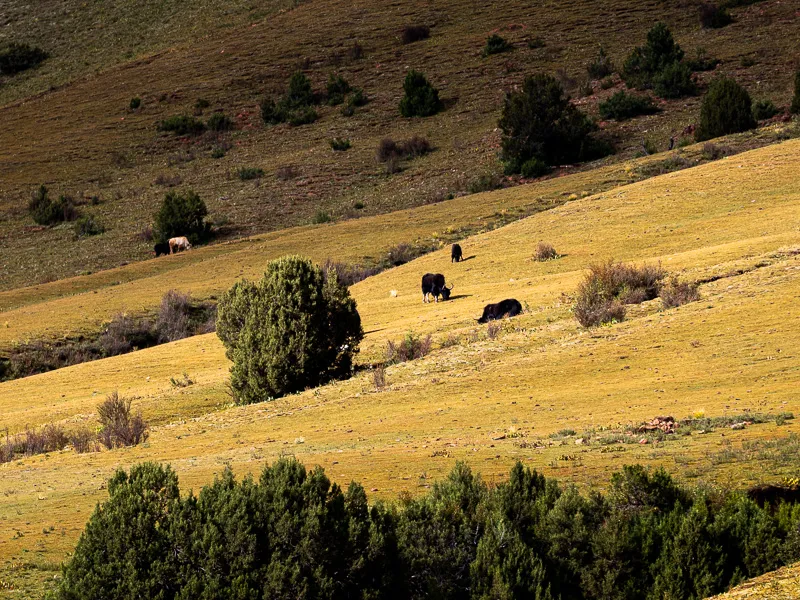
Yaks sitting or standing on the hillside
Canon EOS 5D Mark IV
EF 70-200 f/2.8L IS III USM + 2X III
F6.3 | 1/640 s | 400mm | ISO 250
Sleeping inside the car is always hazy, somewhere between sleeping and waking. The sounds around you seem amplified and distant as they enter your ears. Birds, running water, the wind moving through the valley, all the small sounds that would normally go unnoticed suddenly become clear, making it difficult to tell whether they are real or part of a dream. The feeling was wonderfully relaxing, much like dozing with my head on a classroom desk when I was a child. I do not know how long I slept before the rumble of a passing truck woke me. Everything returned to normal. I checked the time and found that it was already after four in the afternoon.
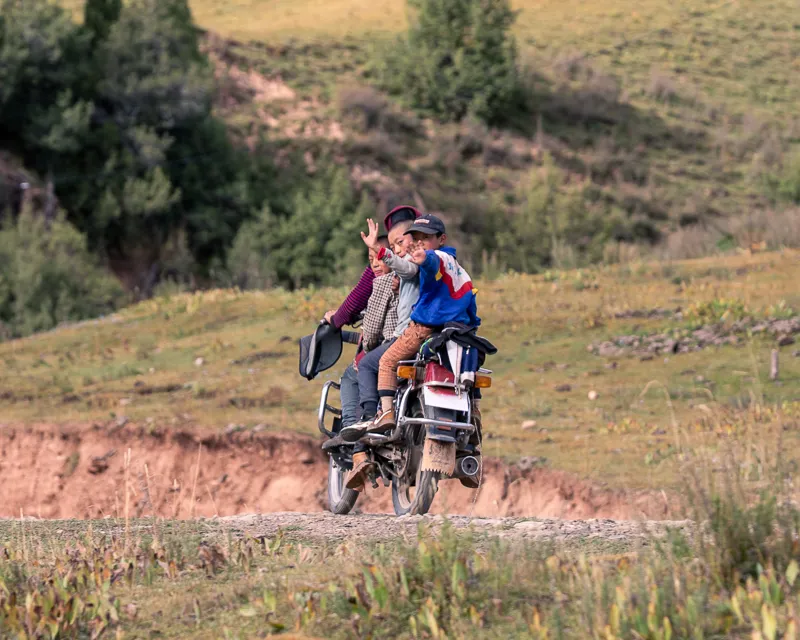
Children passing by would wave at the camera. Very cute.
Canon EOS 5D Mark IV
EF 70-200 f/2.8L IS III USM + 2X III
F8 | 1/200 s | 260mm | ISO 250
Still half asleep, I got out of the car and walked onto the hillside. Small wildflowers covered the slope like a scattered carpet, while white clouds drifted playfully across the distant peaks. I sat down, felt the breeze against me, then lay back on the grass and placed my hat over my face. Everything became quiet. Looking at the sky through the hat was strangely beautiful. Sunlight passed through the tiny gaps in the fabric like a sky filled with stars, but warm instead of cold. I wondered why there was any need to hurry so much. Simply stopping and looking at the scenery beside the road had revealed something so beautiful.
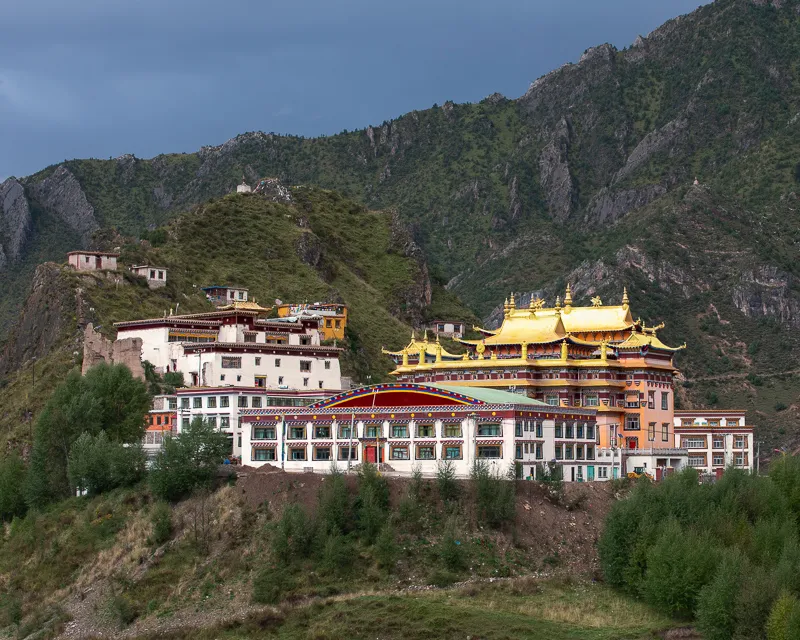
Gading Monastery
Canon EOS 5D Mark IV
EF 70-200 f/2.8L IS III USM
F11 | 1/5 s | 70mm | ISO 100
Continuing along the dirt road, we eventually looped back to Gading Monastery, which we had passed the previous day. By then, the sky had become overcast again. We found a position across from the monastery where the whole complex could be seen and prepared to photograph the golden roofs in the evening light. But the clouds continued to thicken. In the distance, we could already see heavy rain falling from the dark clouds and moving toward us. Only when the car roof began rattling loudly did we realize that it was not rain but hail. Weather on the plateau has a temper of its own.
Bad weather can be remarkable. The dark clouds brought hail and rain, but they also gave Gading Monastery a dark background. The last sunlight of the day lit the golden roofs, while monks finishing their afternoon studies walked out of the monastery and began to enjoy their free time.
As darkness gradually arrived, we also began the drive toward Yushu City. I still did not know what tomorrow’s plan would be. The only thing I knew for certain was that I wanted to value the time spent on the road.
Until Next Time, Duolunduo
Other Information
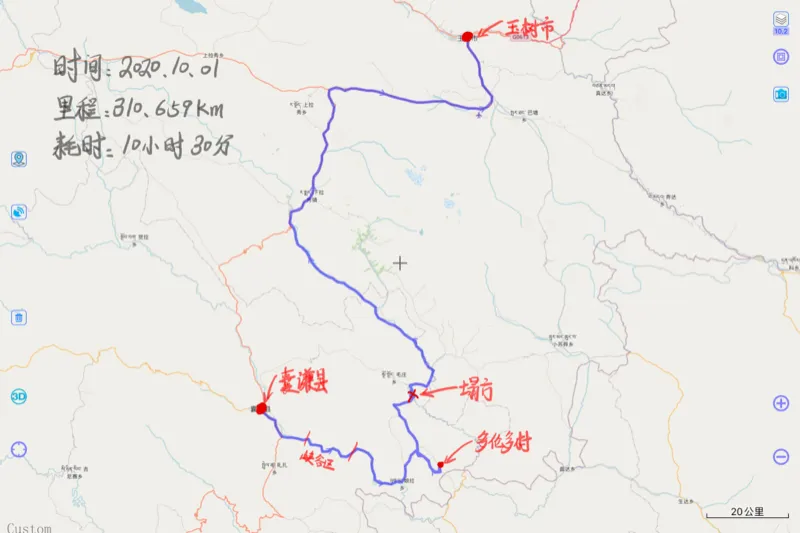
Route map for Day 5
· END ·