Hello, Nangqên
Contents
Nangqên County lies in southeastern Yushu Prefecture, surrounded by the Hengduan Mountains and the Tanggula Mountains. Here, high elevation does not mean barrenness. Abundant summer rainfall covers the mountains in green and fills the landscape with life.
To Xiaosumang Township
The road from Yushu to Batang Township was an old concrete road. Press the accelerator a little harder and the car would immediately begin to shake violently. The locally registered Wulings and Chang’ans seemed exempt from the laws of physics, overtaking us with the ease of martial arts masters.
Fortunately, the poor road ended at Batang Township. The surface became smooth and there were far fewer cars. Under a clear blue morning sky, with dry, cool air coming through the windows and plateau sunlight falling across us, the feeling was difficult to put into words.
The car rounded one bend after another and crossed river after river until a sharp mountain peak suddenly appeared. White clouds, distant mountains, green grass and blue water came together in a quiet pastoral scene.
Rivers on the plateau always seem to have a temperament of their own. No matter how wide or narrow the riverbed, the water is always rushing and jumping, as though in a hurry. The mountains, meanwhile, never hesitate to show their full height, standing openly without hiding anything.
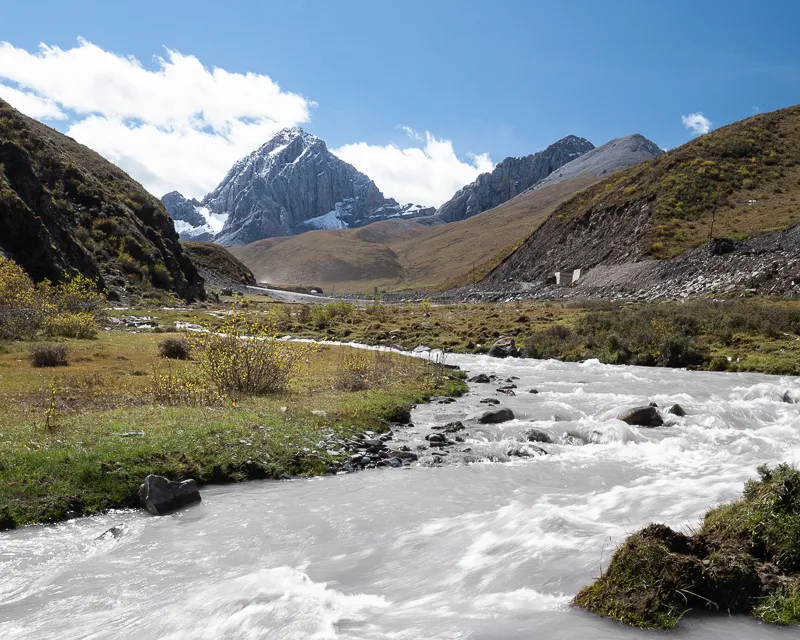
Mountains and winding water
Canon EOS 6D
EF 16-35 f/2.8L III USM
F22 | 1/30 s | 27mm | ISO 100
While we were stopped taking photographs, a locally registered car pulled over beside us. The two people inside had come out from Yushu City for an autumn outing. As our conversation was about to end, one of them casually asked, “Isn’t our Yushu beautiful?”
That simple question made me stop and think. I was born and raised in Qinghai and lived there until I left for university. Back then, I always thought Qinghai was underdeveloped and that the world outside must be more exciting. Only after being away from home for more than ten years did I realize that this land has some of the purest landscapes and most straightforward people, and that nothing can replace it.
We continued along X308. The two people who had spoken to us earlier had already parked by the road and walked onto the grass of a nearby hillside to prepare lunch. When they saw us coming, they waved happily, their sun-reddened faces carrying simple, genuine smiles.
As the road reached the mountain, it became rough again. Construction machinery was working in the distance. Truck drivers parked beside the road, took out the lunches they had prepared, and called to us in their local dialect as we passed: “Time for lunch!” Then they laughed to themselves.
I have always admired those who work in construction and transportation at high altitude: they are resilient, energetic, warm, and remarkably good-humored.
After crossing the pass, the mountain that had required us to look upward to see its full shape was already fading in and out of the rear-view mirror. From this angle, its form looked sharp and upright, standing out clearly against the blue sky and white clouds. The road unfolded from the pass beside the mountain, twisting into the distance.
A young Tibetan couple had parked their motorcycle beside the road and were lying on the grass in the sunshine, enjoying a quiet midday break. Prayer flags snapped in the wind, stirring a sense of reverie in the silent canyon.
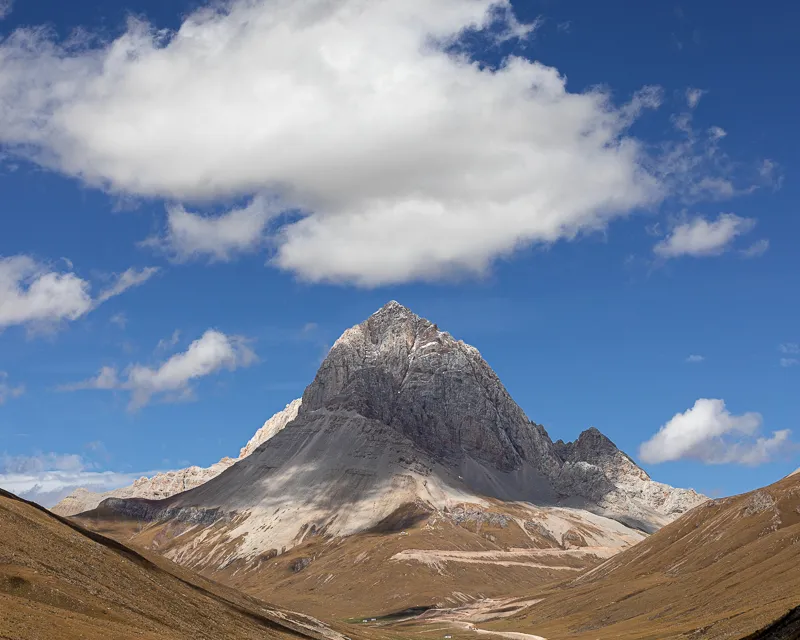
The mountain marks the boundary between Batang Township and Xiaosumang Township. We came along the winding road on its right.
Canon EOS 5D Mark IV
EF 70-200 f/2.8L IS III USM
F11 | 1/640 s | 70mm | ISO 250
Beyond the pass was Xiaosumang Township, part of Yushu City. It lies in a broad, flat valley surrounded by mountains. Although officially a township, it is not very developed. The road passing through it and the single-story houses on either side make up almost the whole place.
At the gas station in Xiaosumang Township, an elderly man filled the car for us. Judging from his accent, he was not local. Perhaps very few tourists stopped here for fuel, because he seemed genuinely pleased to see us. The pump showed 188 yuan. He turned back toward the building to get change, then came out smiling and said, “I’ll give you a discount. 180 yuan. Come back and fill up here again next time!”
I also hoped there would be a next time, and that this would not be the only or the last visit.
Nangqên
South of Xiaosumang lies a region of high mountains. The car rocked from side to side along a road cut by washouts. A roadside speed-limit sign proudly displayed 20, because it surely knew that if you actually drove at 20 km/h here, your backside would complain.
At around three in the afternoon, dark clouds began gathering again in the western sky and rain seemed likely. The weather was almost identical to the previous day’s journey toward Jiangjiaduode.
After a winding mountain section, a group of Tibetans beside the road stopped us. Their car had broken down and they were stranded there. They hoped we could take one of the younger boys to the next village to find help. Unfortunately, our car was packed with too much luggage and there was simply no room for another person. Luckily, vehicles that had passed earlier had already taken several of them back toward Xiaosumang Township. After wishing each other well, we continued on. Not long after crossing the pass, the heavy rain arrived as expected.
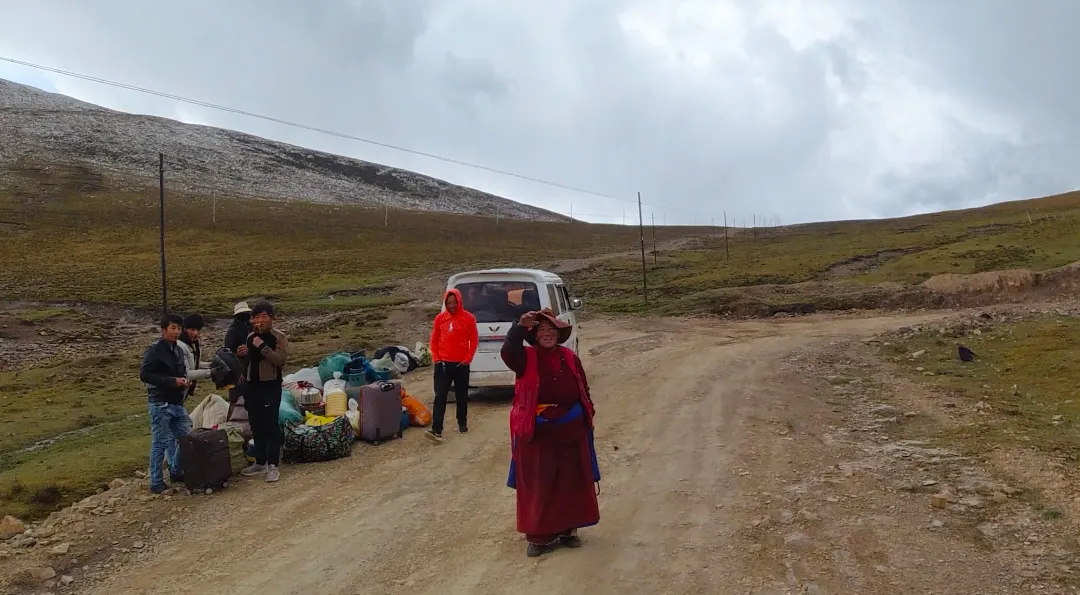
Local Tibetans asking us for help after their car broke down
DJI OSMO Action
Rainstorms on the plateau are brief but intense, arriving quickly and disappearing just as fast. Before darkness had fully settled, the rain had already moved on. The washed air became exceptionally clear, and by coincidence, this was exactly when we entered Nangqên County.
Perhaps because of the rain, everything in Nangqên looked vivid and fresh: the cold, sweet air, rushing rivers, green grass, relaxed horses, orderly Tibetan houses, tall pines and cypresses, and the distant mountains.
There was no dust in the air, no machinery roaring, no crowds, no one fighting for space. There was only calm.
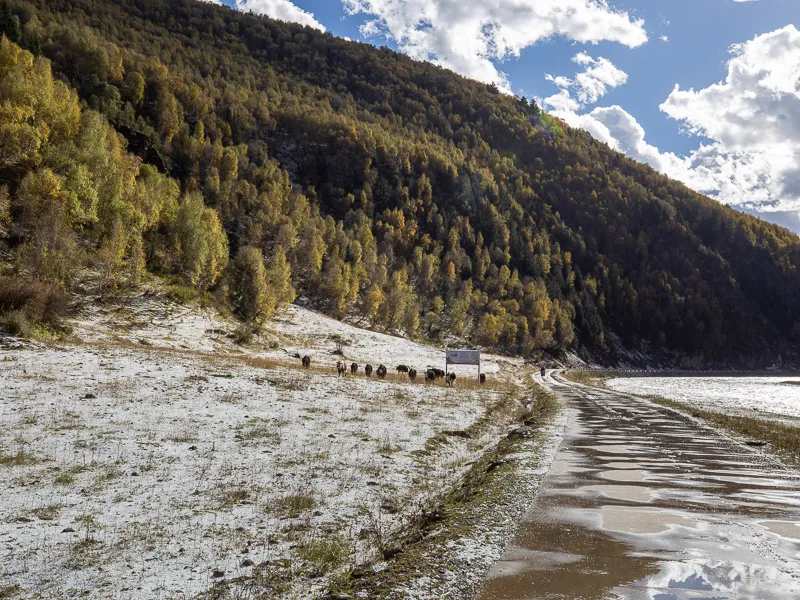
The richly colored forest after the hailstorm
Canon EOS 6D
EF 16-135 f/2.8L III USM
F18 | 1/60 s | 35mm | ISO 100
Accidentally Entering Tibet
Following the valley through village after village, we passed Gading Monastery and continued until we reached a police checkpoint. The guard asked nothing. As soon as he saw a car approaching, he raised the barrier and let us through. Later, when talking with local Tibetans, we learned that this was a nature reserve, although I did not catch its exact name.
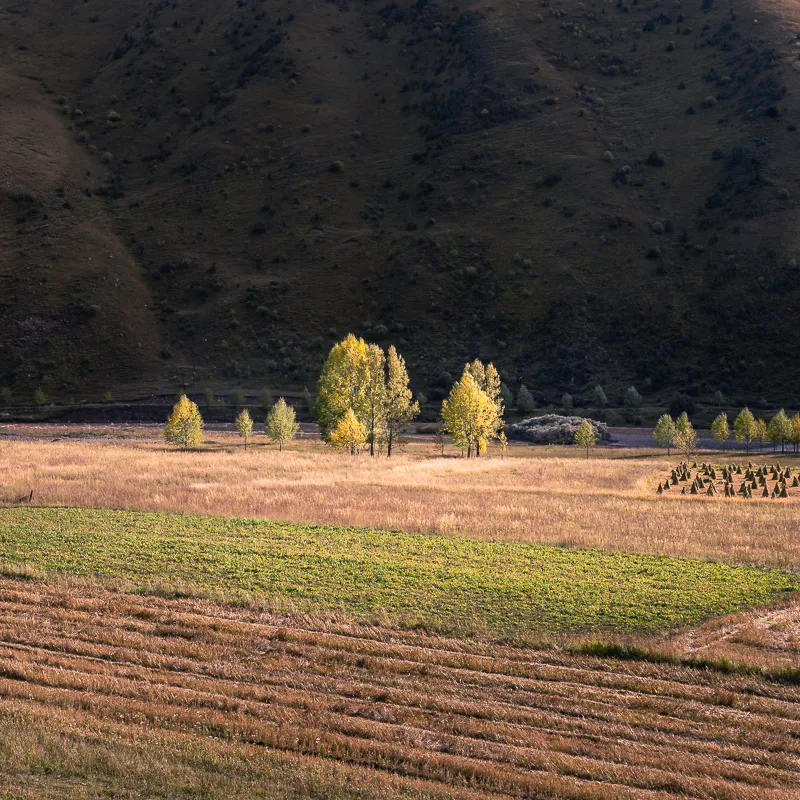
Near Gading Monastery, sunlight happened to illuminate the trees
Canon EOS 6D
EF 24-70 f/2.8L II USM
F14 | 1/80 s | 35mm | ISO 100
The road through the reserve ran between the river and the cliff. Sections were frequently damaged by floods or landslides. There were relatively few trees on the steep slopes, leaving the rock exposed. The fast-flowing river struck the cliff walls with enormous force, and the sound echoed back from the rock, becoming even louder.
The flatter areas were covered in dense forest. The trees looked old, with many fallen trunks lying on the ground. Beside those dead trees, new saplings were already growing, repeating the cycle again.
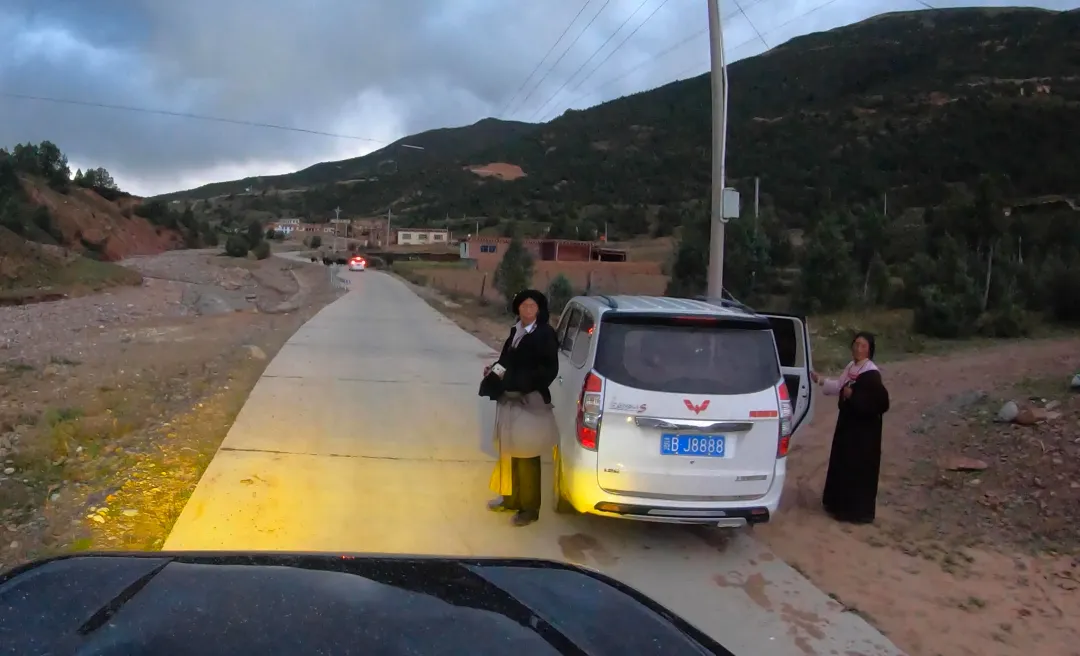
Local Tibetans in Qamdo, Tibet, wishing us a safe journey. The license plate on the Wuling was particularly noticeable.
Gopro 7
Not far after leaving the reserve, the damaged concrete road suddenly gave way to smooth asphalt. This was the boundary between Yushu in Qinghai and Qamdo in Tibet. Driving on the smooth surface felt so pleasant that by the time we looked at the map again, we realized we had already missed our turn. We turned around and returned to the planned route. After crossing a bridge, the asphalt became a narrow concrete road again.
Looking at the map, today’s most important destination, Duolunduo, was not far ahead. With the road now so smooth, I optimistically assumed we would arrive quickly. But when we reached the provincial boundary again, a vast riverbed appeared in front of us.
The road had disappeared again.
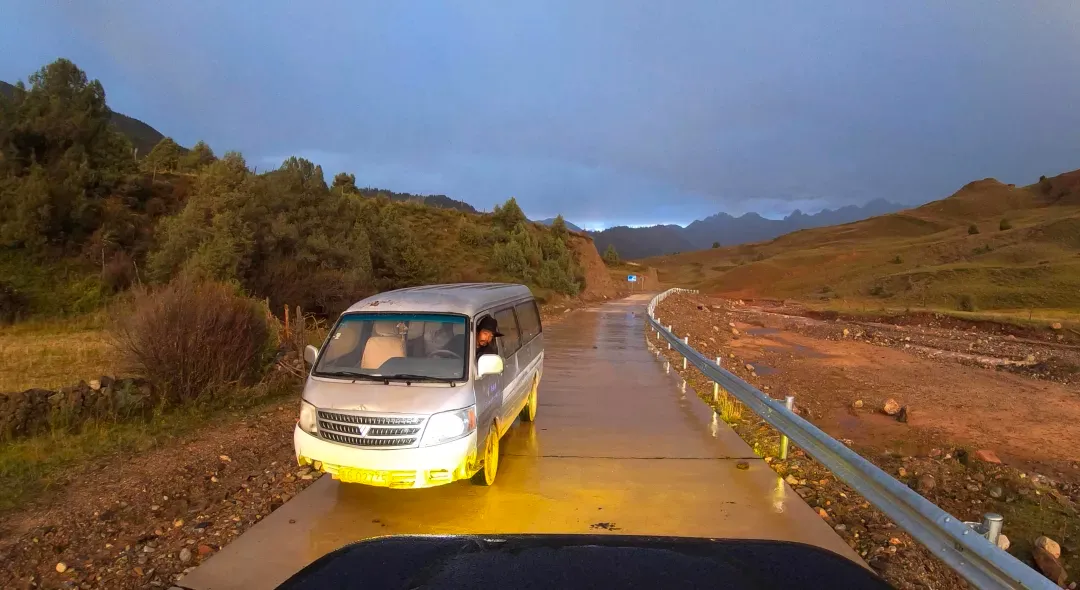
Thanks to this handsome Tibetan man, our plan was saved.
Gopro 7
At that moment, a Tibetan man appeared just when we needed help and kept our plan from falling apart. He led us out of the difficult section and safely to our destination, Duolunduo, a village full of stories.
· END ·