Notes on Yangmei
Contents
Yangmei are grown mainly in southeastern China. They ripen in midsummer: round, dark red fruit, sweet and tart, full of juice and unlike anything else. To me, they are the black pearls of the fruit world. They grow across much of eastern China, and almost every part of Zhejiang is suited to them.
Within Zhejiang, Xianju is known above all for its yangmei. This county of Taizhou is famous for ranks of rugged peaks and fruit as large as ping-pong balls. Every year after the Dragon Boat Festival, waiting for the yangmei to ripen becomes a matter of great importance to me. The timing shifts by a week or two depending on the rain and sunshine, but the end of June is always the best time to eat them.
“A horseman raises red dust, and the consort smiles; no one knows it is lychees on the way.” I suspect Yang Guifei never tasted a fresh yangmei. In an age without refrigerated transport, there was no way to carry them from Jiangsu or Zhejiang to Chang’an in the summer heat—even overnight delivery could not have preserved their particular flavor and texture. That is why I like going to Xianju to buy them myself. Buying fruit is the stated purpose, but the journey is really an excuse to get out and see what I might find. Sit indoors for too long during the plum rains and you begin to grow mold yourself. You have to go outside and get some sun.
The Song-dynasty monk Shi Zuke wrote, “By the fifth month, yangmei fill the woods; at first glance, each one seems worth a thousand pieces of gold.” The end of June falls around the middle of the fifth lunar month, near the close of the plum-rain season. In a good year, the rains have already passed, typhoon season has arrived and the days are mostly clear. In a bad one, the rain drags on, everything turns clammy and floods spread. This year has mostly been the latter.
For five years running, I made a special trip to Xianju—or at least passed through—after the Dragon Boat Festival, just to taste yangmei picked that day. The fruit keeps poorly, so growers have to pick and ship it within hours. They begin work in the hills before sunrise, move the harvest into cold storage, and by midday are already packing it into boxes. To taste yangmei at its freshest, you have to arrive early. Like fresh beer, leave it sitting and something escapes.
I am ashamed to admit that I have never tasted a morning yangmei. I have been to Xianju many times, but I always lingered over the scenery along the way and never arrived before the afternoon. With bad luck and a late start, it was not unusual to find nothing left at all. Back then, I thought that living in Hangzhou meant there would always be another chance to get up early and try again. If not this time, then next time.
There are many places along the road to Xianju that make me think, “I’ll come back next time.” One returns to me more than the others: a field of water bamboo moving in the summer breeze. A field beneath a blue sky, wind passing through it in waves—a scene from a dream that I cannot let go. I wanted to step inside the picture and stay there, sitting by the roadside, watching, lingering, thinking, held in that moment forever.
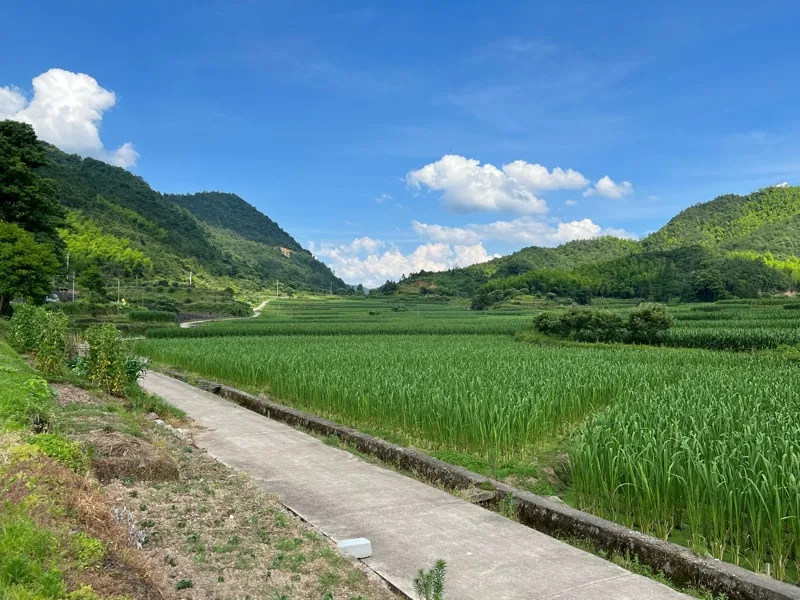
Summer on the way to Xianju, 2022.
Again and again, those good days return in dreams and in memory. Nothing dramatic ever happened. What mattered was the company: friends, a partner, family. Being together was enough. Even without speaking, the silence said more than words.
I remember a few summer weekends in high school when a close friend and I climbed into the mountains to empty our minds. The sky over the Tibetan Plateau was intensely blue, and the sun had a bite—the blue dazzled and the heat burned. We would lie there with an incomprehensible book over our faces, and the afternoon would pass quietly. How good those days were. If only I could have gone on lying beneath that blue sky with my closest friend.
I do not like change. Put kindly, I ask little of the world. Put less kindly, I lack ambition. I am fond of lacking ambition. Against all reason, I want the people, things and landscapes around me to remain unchanged forever, content to drift with me in the same directionless way. I want to repeat the same daily boredom and the same dreams with old friends. But how could that ever be possible? In a rushing current, even a fallen leaf cannot remain untouched. In the whirlpool of an age, ordinary people wear themselves out simply trying to keep up. Change always comes from outside.
And so I left for a distant place. More than a year and a half has passed without my noticing, and I can barely remember the taste of yangmei. Color-blind eyes cannot see every shade in the world; perhaps the world has to be tasted instead. Sour, sweet, bitter and hot—so this is what life tastes like. There seems to be less sweetness than anything else, but it is sweetness that makes us happy. Picked too early, yangmei are fiercely sour. They are sweet for only a brief fortnight. Sweet yangmei are delicious, but the sour ones are unforgettable.
There are four seasons, twelve months and twenty-four solar terms in a year, yet this flavor can be found only between Grain in Ear and Minor Heat. Whenever my thoughts reach this point, I begin to miss the old days again. Like dumplings at Lunar New Year, yangmei have become a sign of summer. When the temperature rises and I am drenched in sweat, trying to catch my breath, I think of yangmei and their cool sweetness.
Yang Guifei, I imagine, never did taste one. How could an imperial consort deep inside the palace have understood a fruit that could be either sour or sweet?
Begun during the Dragon Boat Festival in the Jiachen year, 2024
SYD, NSW, AUS
20240817