The Jiangjiaduode We Never Saw
Contents
Sacred Mount Jiangjiaduode holds the blue waters of Suo’e Lake in its embrace, quietly looking toward Yushu City 100 kilometers away. Wrapped in cloud and mist, it hid itself from us, unwilling to be disturbed.
Yushu City
Yushu City is the southernmost city in Qinghai Province and the capital of Yushu Prefecture. From the people on the streets to the buildings, the whole city has a distinctive Tibetan character that invites visitors to linger. Its roads are clean and orderly, its buildings arranged with care, and the bright sunlight unique to the plateau fills the city with energy. I like this particular kind of plateau sunlight. It gives people a sense of hope and happiness and makes worries easier to forget.
I had never visited Yushu before the earthquake, so I cannot compare what it was like then with what it is now. But judging from the city as it stands today, it has already exceeded my expectations. There are only a handful of places in Qinghai officially classified as cities, and I have also visited Delingha, Golmud, Haidong and Mangnai. Yet Yushu is the most distinctive of them. Jyekundo Monastery overlooking the whole city and the statue of King Gesar standing in the square both speak of its culture and history.
The speed limit in central Yushu is 40 km/h. Coming from Hangzhou, where I lived, that seemed almost unbelievably slow. But in this plateau city, such a low speed limit does not seem to bother anyone. Instead, it contributes to a sense of calm. At high altitude, where oxygen is thin, both people and vehicles are being tested by nature. Going fast is rarely the best choice.
Jiangjiaduode
From Yushu City, we drove south along the Batang River and then turned onto a wide but uneven dirt road. According to the map, this road would continue toward Jiangjiaduode. When we left Yushu City, dark clouds were already beginning to gather on the horizon. We drove south with the clouds filling the entire rear-view mirror. They did not catch up with us for a while, which was a relief, though I was still a little worried.
Not long after entering the dirt road, we were stopped at a checkpoint. A sign beside it told us that the area ahead was protected and that visitors should take care of the environment. We waited for a while, but no one came out. I got out of the car and walked to the window of the small checkpoint building. A family was living inside. When the daughter saw me approaching, she woke her sleeping father. He came outside and explained the rules: we were not allowed to take away any wood or stones, and he would inspect the vehicle when we returned. Then he raised the barrier and let us through.
After nearly an hour bouncing along this pothole-filled road, we turned onto another smaller road heading west, and the real challenge began. In addition to deeper potholes, the road was covered with large numbers of rounded stones. Some were embedded in the ground and protruded slightly, while others completely covered the surface. The road rose and fell and tilted from side to side, making the drive even more difficult. At the same time, the dark clouds that had been trailing behind finally caught up, and a light rain began to fall.
This section was nearly six kilometers long, and right from the beginning I was tempted to turn back. But with the thought that “we’ve come this far, we should at least have a look”, I forced myself to continue for another kilometer. The road then improved slightly, becoming a little straighter with fewer stones. After more bouncing along, snow-covered peaks gradually appeared ahead. Perhaps that was Jiangjiaduode.
But the hope did not last long. The road suddenly ended and disappeared into the open grassland. Faint tire tracks could still be seen, but considering that we were traveling alone and it had started raining, we decided not to continue. We would not see Jiangjiaduode this time.
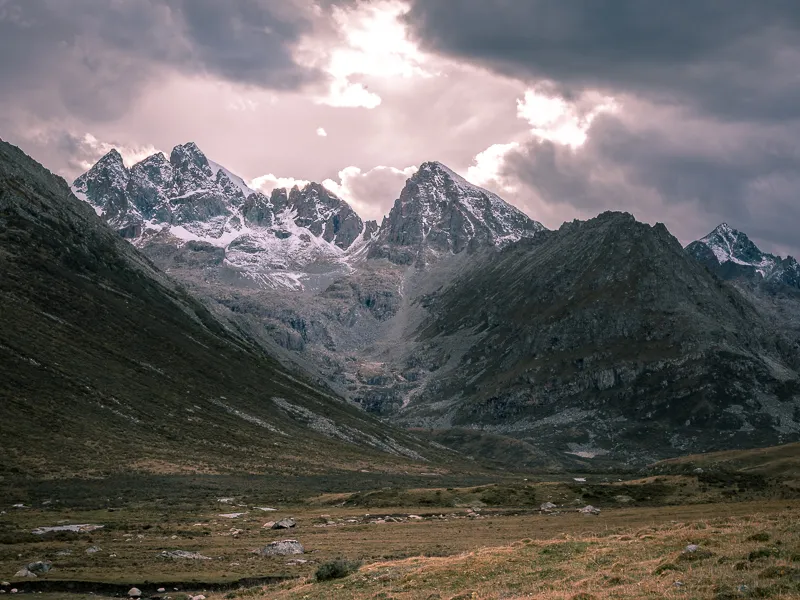
Jiangjiaduode, when sunlight suddenly appeared on the return journey
Canon EOS 5D Mark IV
EF 70-200 f/2.8L IS III USM
F22 | 1/15 s | 88mm | ISO 100
Much as I hated to give up, I had to accept reality. Getting stuck in such a remote place with no way to recover the vehicle ourselves would be a serious problem. It was already getting late, so after taking a photograph, we began the return journey, hoping to get out of this bad section before dark.
The Return Journey
Retracing the same road was much easier and more enjoyable. We already knew the road conditions and how long it would take, so the pace was easier to judge. The thick clouds above us were changing quickly, and before long sunlight broke through in the direction of Jiangjiaduode. Even though we were in a hurry to return, I could not resist the evening light. I kept telling myself, “I’ll only look for a moment,” but my feet had already stepped out of the car.
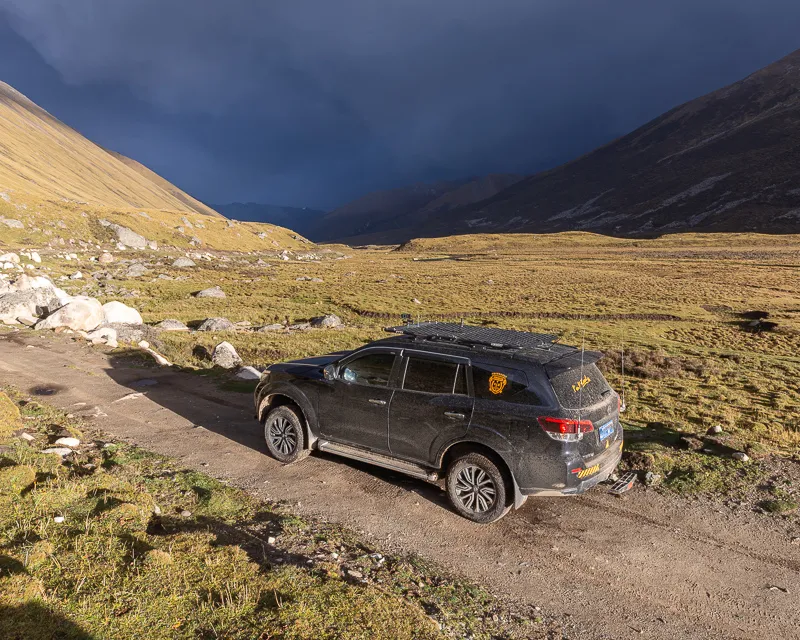
The return journey
Canon EOS 6D
EF 24-70 f/2.8L II USM
F16 | 1/100 s | 88mm | ISO 100
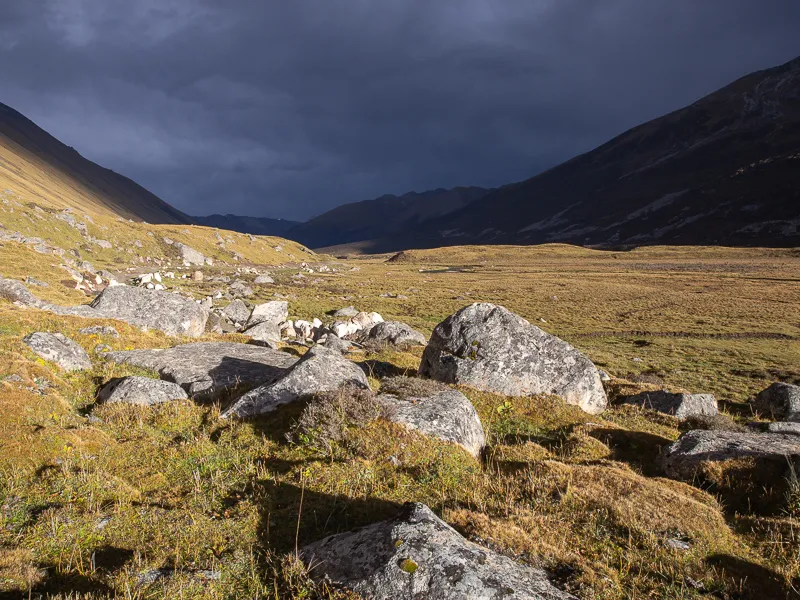
Loose stones
Canon EOS 6D
EF 24-70 f/2.8L II USM
F20 | 1/25 s | 24mm | ISO 100
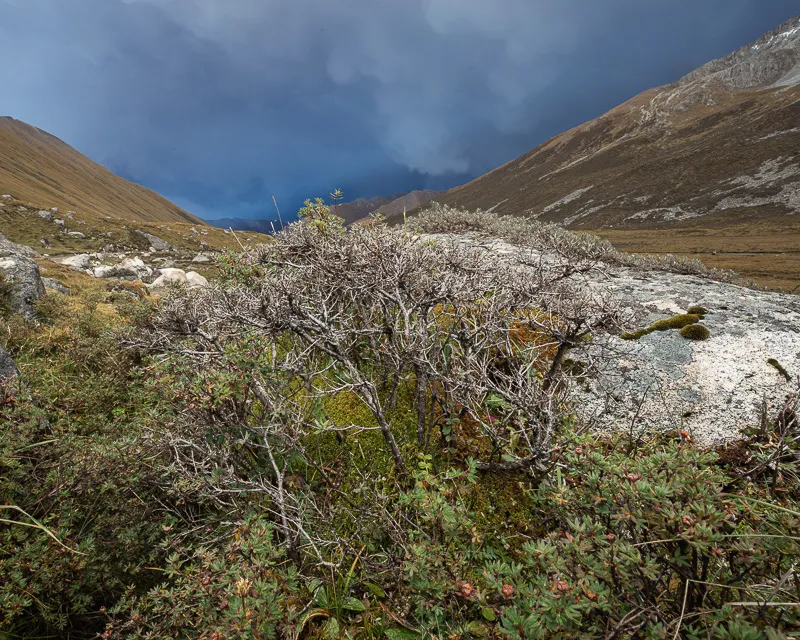
Dark clouds
Canon EOS 6D
EF 16-35 f/2.8L III USM
F22 | 1/4 s | 18mm | ISO 100
There were no hillsides covered in flowers in this empty valley, but everything was still covered in thick green grass. The setting sun was bright and dazzling, shining from the direction of Jiangjiaduode and stretching the shadows of both people and vehicles. I kept adjusting the camera eagerly, moving from one position to another but never quite finding a composition or light that satisfied me. Before long, the clouds thickened again and the light faded. Reluctant as I was, I had no choice but to get back into the car and slowly drive away.
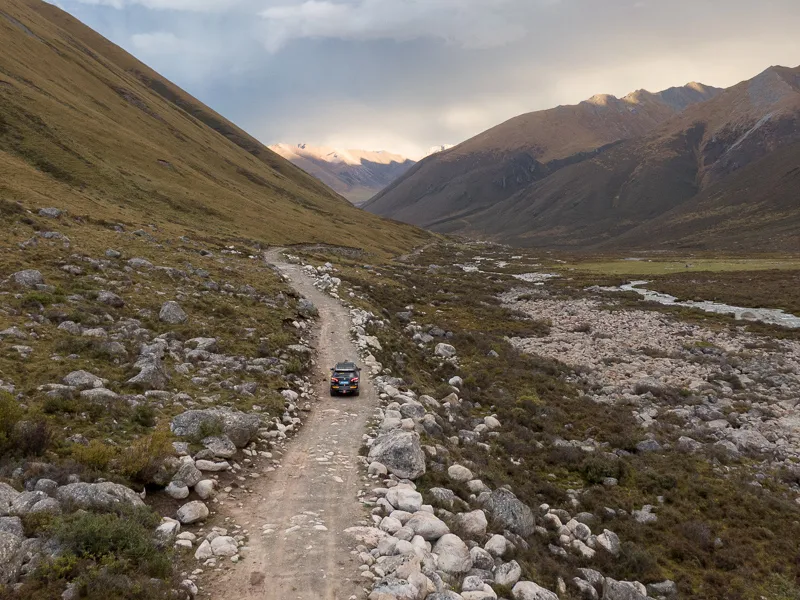
The road back
DJI Mavic 2 Zoom
F2.8 | 1/80 s | 4.39mm | ISO 110
Fortunately, we managed to leave the rocky road before dark and return to the pothole-filled track. In the canyon, apart from the deep blue sky that had not yet turned completely black, the only things visible were those illuminated by the headlights. Yaks occasionally stood beside the road and trotted away as we approached. Just when I thought the day’s journey was nearly over, another surprise appeared. A large animal entered the beam of the headlights. At first I thought it was a horse, but as we drove closer, a huge pair of antlers caught the light. It was an adult male deer. When the car approached, it stood up and ran, leaping from the road toward the riverbank before quickly disappearing into the darkness. After researching it later, I concluded that it was an adult white-lipped deer, a Class I nationally protected species in China.
Back at the checkpoint, the guard confirmed that we had not taken any wood or stones and then asked what we had gone in there to do. I told him truthfully that we had gone to see Jiangjiaduode, and asked why the road had simply disappeared at the end. Had we taken the wrong route? The guard tried for some time to explain in hesitant Mandarin, but I still could not understand him. Only when he began marching in place did I suddenly realize what he meant: the rest of the route had to be walked.
“You have to hike for a while?” I asked.
He nodded excitedly.
He was the first Tibetan person I spoke with in Yushu, serious in a slightly endearing way. Later, we met many more Tibetan people who were sincere, endearing and eager to help, and they gave this journey a meaning of its own.
· END ·