Winter in Yangzhou (Part I)
Contents
Near the meeting point of the Beijing–Hangzhou Grand Canal and the Yangtze River lies Yangzhou, a city that has left a deep mark on Chinese history. Compared with the familiar image of “journeying to Yangzhou in March, when blossoms are veiled in mist,” Yangzhou in winter feels a little quieter and more subdued, but has a character of its own.
Going to Yangzhou
Leaving aside the cities where I have worked and my hometown, Yangzhou is probably the city I have visited most often. Part of the reason is that it is fairly close to Hangzhou, but more importantly, it has its own history and culture, as well as a relatively well-preserved old city. From my own experience, among cities with an important historical place that have also managed to balance urban development with the preservation of history and culture, Yangzhou is one of the best.
When people mention Yangzhou, the first thing that probably comes to mind is Yangzhou fried rice. But it is a little like Hangzhou xiaolongbao or Chongqing chicken hotpot: something local people themselves do not necessarily know much about. In fact, Yangzhou does hold an important place in Chinese cuisine. Huaiyang cuisine, which originated here, is traditionally regarded alongside Sichuan, Shandong and Cantonese cuisine as one of China’s four major cuisines. Huaiyang cuisine places particular emphasis on precise knife work and has some of the highest demands in this respect among the four cuisines. One of its representative dishes, Wensi tofu, appeared in the first season of A Bite of China. Its fine and demanding knife work makes it a good example of the delicacy of Huaiyang cuisine.
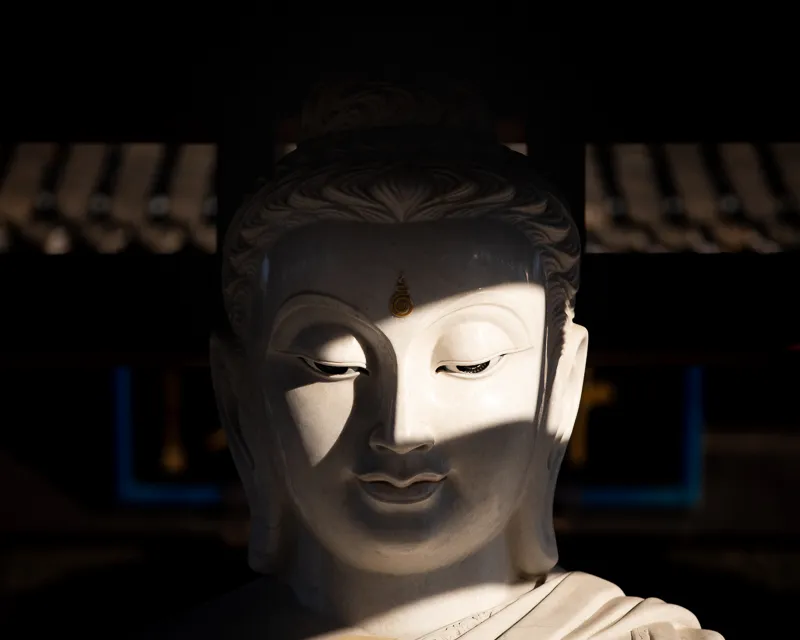
A beam of morning light illuminates the face of a Buddha statue.
Canon EOS 5D Mark IV
EF 70-200 f/2.8L IS III USM
F3.2 | 1/1250 s | 200mm | ISO 100
Beyond food, Yangzhou’s place in Chinese history is equally significant. Founded before the Common Era, the city has accompanied much of the rise and fall of Chinese history and carries marks left by many different dynasties. Some of those traces have disappeared with time, while others were destroyed by war or human action. But in the old residences, historic districts, culture and food that remain, it is still possible to sense the city’s former prosperity and importance, and the influence it once had on China and even the wider East Asian region.
Daming Temple
If I had to choose the place that best represents Yangzhou for me, it would be Daming Temple. It stands on the central ridge of Shugang, a wooded scenic area on the northwestern outskirts of the city, and is one of the best-known ancient temples in China and abroad. It was first built during the Daming era of Emperor Xiaowu of the Liu Song dynasty, which gave the temple its name. During the Sui, Tang, Qing and other dynasties that followed, Daming Temple went through repeated periods of prosperity and destruction. In 1957, it was listed as a provincial-level protected cultural site in Jiangsu; in 1963, the temple buildings were restored. During the Cultural Revolution, because it was under special protection, it became the only temple in Yangzhou whose Buddhist statues were not destroyed. In 1979, the Jiangsu Provincial People’s Government funded a full restoration. In April 1980, when a seated statue of Master Jianzhen returned to Yangzhou from Japan, the temple resumed the name “Daming Temple”.
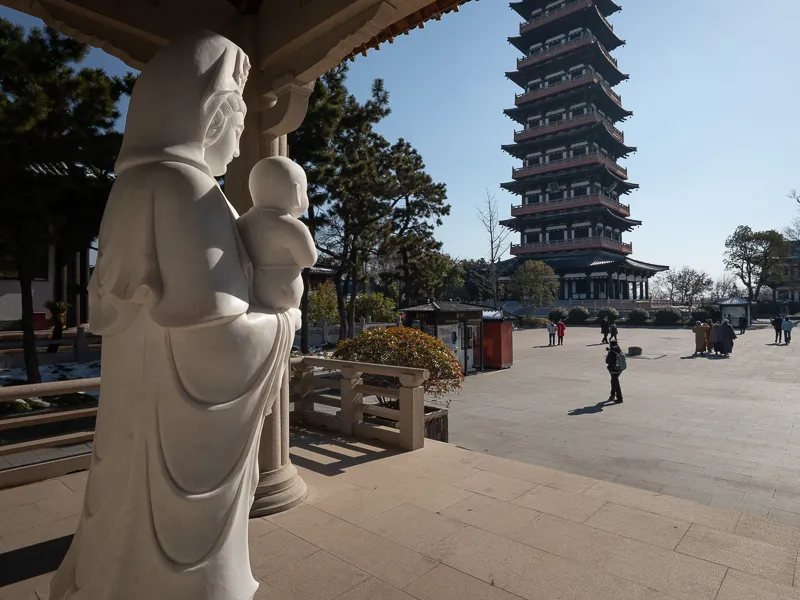
The eastern courtyard of Daming Temple
Canon EOS 5D Mark IV
EF 16-35 f/2.8L III USM
F10 | 1/250 s | 20mm | ISO 100
Covering more than 500 mu, Daming Temple is made up of many historic and reconstructed buildings, including temple monuments, Qiling Pagoda, the Jianzhen Memorial Hall, the Reclining Buddha Hall, Pingshan Hall and the Fifth Spring. Li Bai, Bai Juyi, Su Shi, Ouyang Xiu, Wang Anshi and many other poets and writers visited Daming Temple and left poems praising this place, once known as the “finest temple east of the Huai River”.
Qiling Pagoda
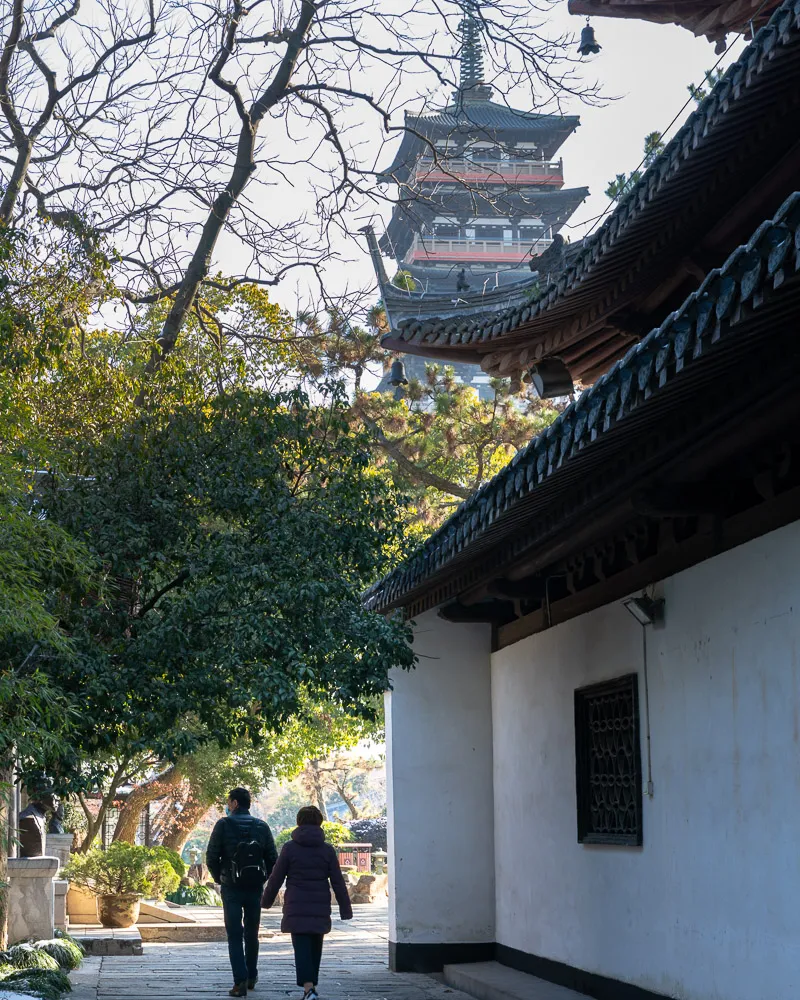
Walking through the temple among green trees and grass, stone tablets and old buildings tell stories from different dynasties and different lives. In the eastern garden stands a square nine-storey pagoda. This is the reconstructed Qiling Pagoda. The original pagoda was built in the first year of the Renshou era under Emperor Wen of Sui. Buddhist relics were enshrined inside, and because it was believed that the spirit of the Buddha rested here, it was called Qiling Pagoda. Daming Temple itself was once renamed Qiling Temple because of it.
By the Sui and Tang dynasties, Yangzhou had become China’s third-largest city after Chang’an and Luoyang, and many well-known figures came here to visit. Li Bai, Liu Changqing, Liu Yuxi and others climbed the pagoda and wrote poems about what they saw.
The treasured pagoda rises into the blue,
I climb high and look across the four directions.
At its summit, heaven and earth seem to meet,
Its form rises above the distant clouds.
— Li Bai
Qiling Pagoda, however, was destroyed by fire in the third year of the Huichang era of the Tang dynasty. Apart from the poems that survived, no images, drawings or paintings of the original pagoda remained. In 1980, when the statue of Master Jianzhen returned to Yangzhou, people from various circles proposed rebuilding Qiling Pagoda. In 1988, Master Ruixiang, abbot of Daming Temple, selected a site in the eastern garden and laid the foundation stone. After his death, Master Nengxiu took charge of Daming Temple and oversaw the reconstruction. Drilling began on 13 September 1993, piling began on 7 December that year, and the pagoda was completed in December 1995.
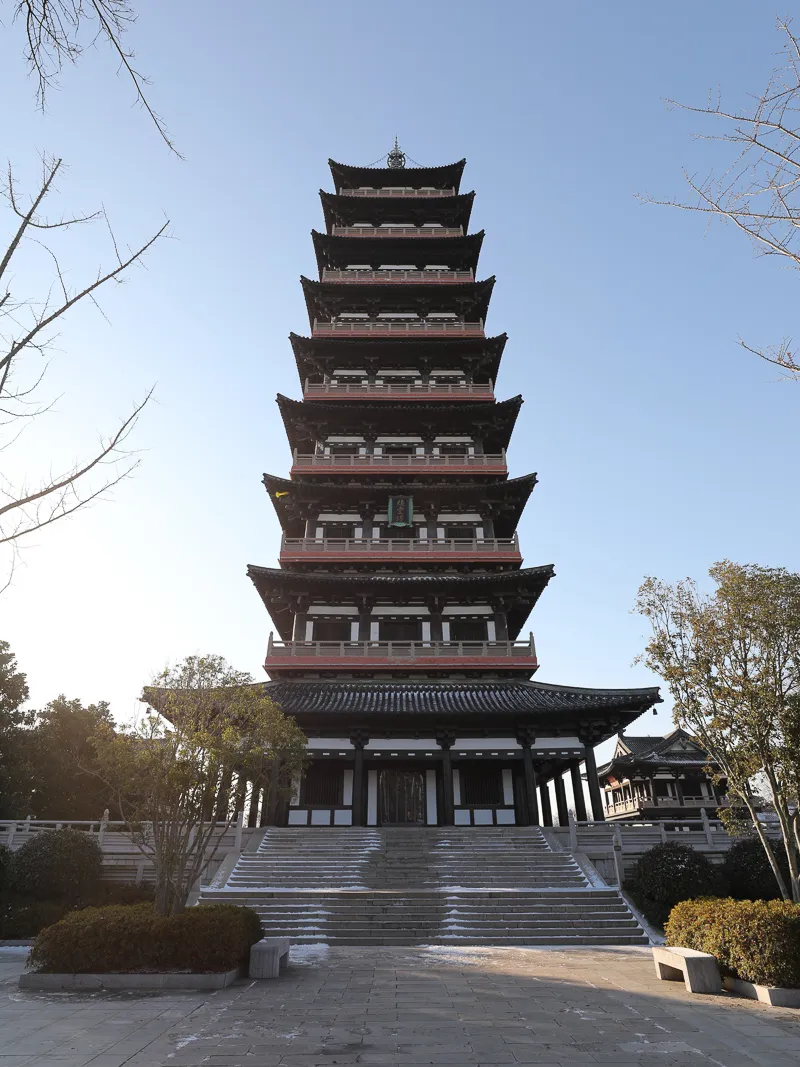
Qiling Pagoda
Canon EOS 5D Mark IV
EF 16-35 f/2.8L III USM
F3.2 | 1/1250 s | 16mm | ISO 100
To reproduce the original appearance of Qiling Pagoda as closely as possible, Pan Dehua, an expert in historic architecture at the Yangzhou Architectural Design Institute, was given the task of designing it. With no surviving images or plans, clues had to be found in poems written by people who had climbed the pagoda over the centuries. The original Qiling Pagoda had been built in the Sui dynasty, but very few Sui buildings survive in China, apart from structures such as the Four-Gate Pagoda at Shentong Temple in Licheng, Shandong, and Anji Bridge in Zhao County, Hebei. At Hōryū-ji in Nara, Japan, stands a five-storey pagoda built in AD 607, when China was under the Sui dynasty.. It is a medium-sized wooden pagoda and one of the oldest surviving wooden structures in the world, making it an important reference for the design of Qiling Pagoda. Because the design team could not travel to Japan to study it directly, they had to work from available materials and infer its structure. The final design was a square, nine-storey, pavilion-style pagoda, with a three-bay surrounding aisle, one doorway and two windows, raised floors and a nine-tiered finial.
Jianzhen Memorial Hall
What interests me most about Daming Temple is the story of the Tang dynasty monk Jianzhen. To spread Buddhism to Japan, he attempted the voyage east six times. Five attempts ended in failure, and along the way he lost his sight. On the sixth attempt, he finally reached Japan, bringing with him Buddhist teachings as well as advanced Tang knowledge of medicine and architecture.
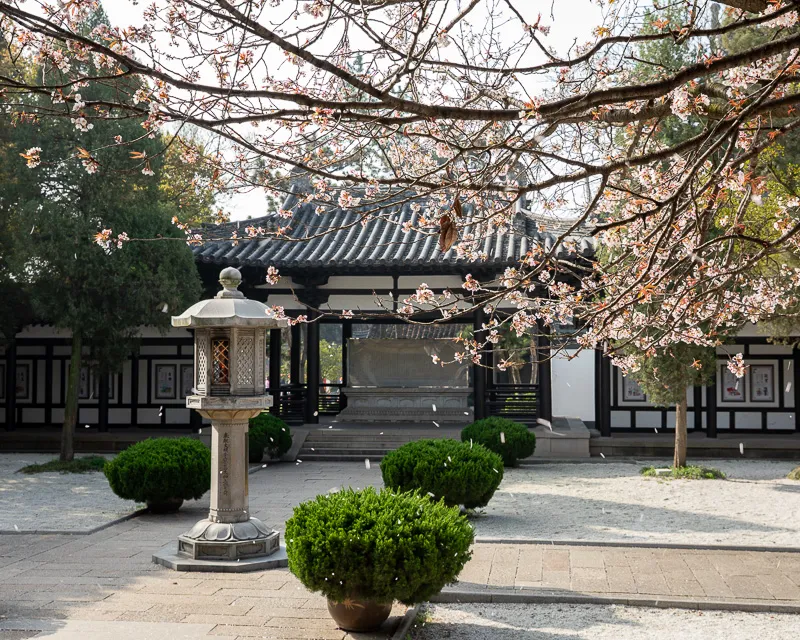
Cherry blossoms falling in front of the Jianzhen Memorial Hall in spring. This photograph was taken in April, not January. The two cherry trees were also transplanted from Japan.
Canon EOS 5D Mark IV
EF 24-70 f/2.8L II USM
F8.0 | 1/60 s | 38mm | ISO 100
In 1963, 1,200 years after Jianzhen’s death, people from Buddhist, literary, artistic and medical circles in both China and Japan held memorial ceremonies. China also decided to build a memorial hall in Yangzhou, Jianzhen’s hometown, to commemorate the monk who had helped lay the foundations for friendship between China and Japan. The hall was built inside Daming Temple on the central ridge of Shugang, north of Yangzhou, and was designed by the architect Liang Sicheng.
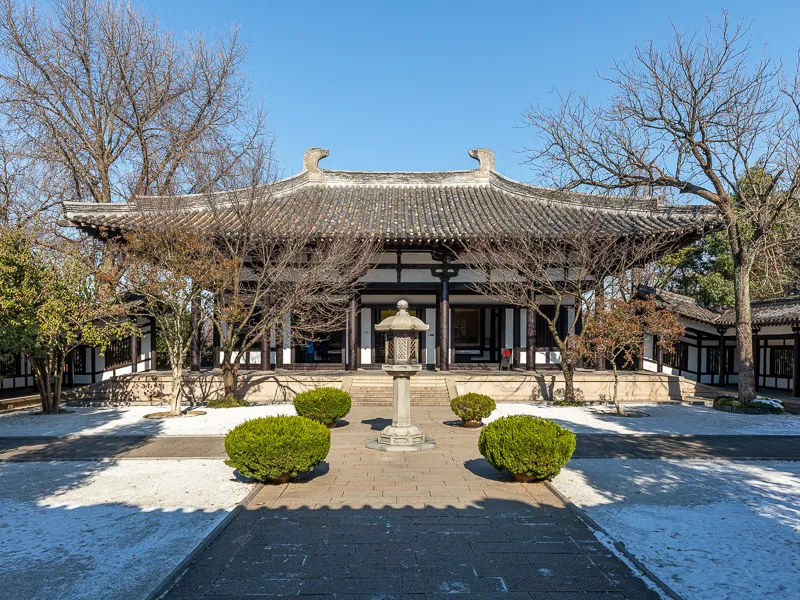
The courtyard of the Jianzhen Memorial Hall
Canon EOS 5D Mark IV
EF 16-35 f/2.8L III USM
F9.0 | 1/160 s | 22mm | ISO 100
The Jianzhen Memorial Hall is a square courtyard covering 2,540 square meters, consisting of the memorial hall, a stele pavilion and covered corridors. The main hall faces south and was designed in the style of the Golden Hall of Tōshōdai-ji in Nara, Japan. Its main structure has a single-eaved hip roof and stands on a low platform. Directly opposite is the stele pavilion. At its center stands a white marble stele on a Sumeru pedestal. The front bears the inscription “Memorial Stele to the Great Tang Monk Jianzhen”, written by the modern writer Guo Moruo, while the back carries a long inscription composed by Zhao Puchu, then president of the Buddhist Association of China.
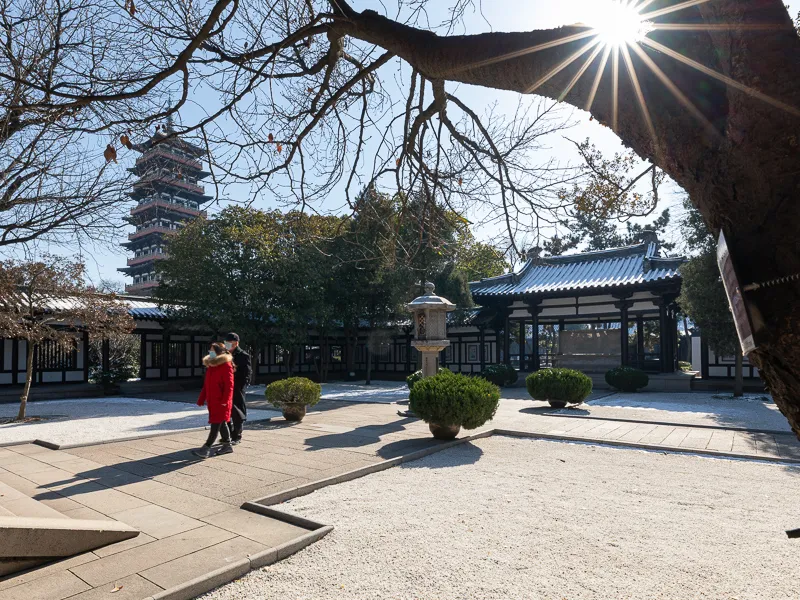
The stele pavilion and Qiling Pagoda
Canon EOS 5D Mark IV
EF 16-35 f/2.8L III USM
F16 | 1/40 s | 18mm | ISO 100
At the center of the courtyard stands an eternal lamp. In 1980, when Jianzhen’s dry-lacquer statue was brought back to Yangzhou for exhibition, Elder Morimoto of Tōshōdai-ji personally brought the lamp from Japan and lit it here. An identical lamp stands at Tōshōdai-ji in Nara. The two lamps, one in China and one in Japan, form a pair and symbolize the hope of lasting friendship between the people of the two countries.
As an early figure linking China and Japan, Jianzhen set out in the first year of the Tianbao era of the Tang dynasty after being invited by the Japanese monks Yōei and Fushō to travel to Japan and teach Buddhism. Before leaving, Jianzhen asked his disciples who would be willing to make the long and difficult journey. None dared accept the task. Jianzhen then said: “This is for the Dharma. Why should we spare our lives? If none of you will go, then I will go.” He was already fifty-five years old when he made the decision.
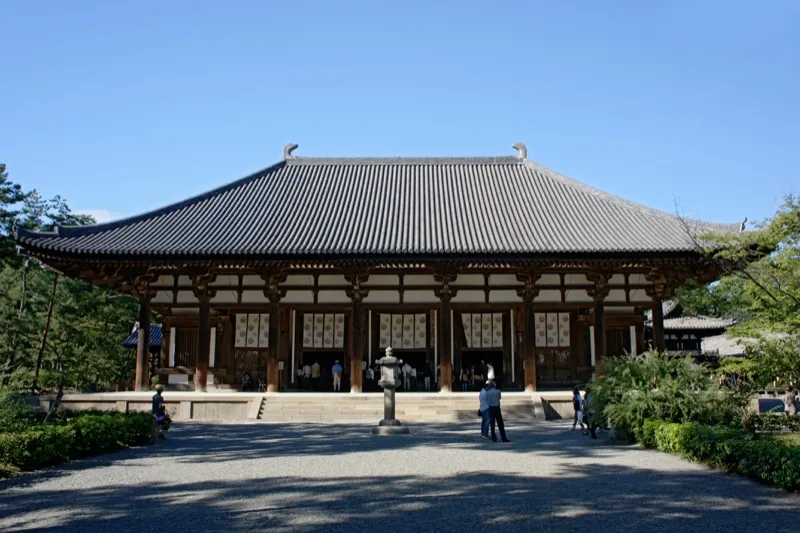
The Golden Hall of Tōshōdai-ji in Nara, Japan
Image from Wikipedia
The first attempt failed after a Korean monk made a false accusation, and the party did not leave Yangzhou; the second failed because of strong winds and rough seas before they could leave the Yangtze; the third ended when their ship struck a reef, and they were rescued and taken to Ayuwang Temple in Ningbo; the fourth was stopped by local officials, and Jianzhen was sent back to Yangzhou; the fifth encountered a typhoon and drifted all the way to Hainan. By then, Jianzhen was over sixty. Meanwhile, Yōei, one of the Japanese monks who had originally invited him, died of illness, while Fushō left to arrange another ship to Japan. One had died and the other had departed, but this only strengthened Jianzhen’s resolve: “To transmit the precepts and spread the Dharma, I have decided to cross east. Until I reach Japan, I will not change my mind.” Worse still, an eye infection left him blind. In 753, Jianzhen boarded a returning Japanese mission ship and finally crossed the sea successfully, landing in Satsuma.
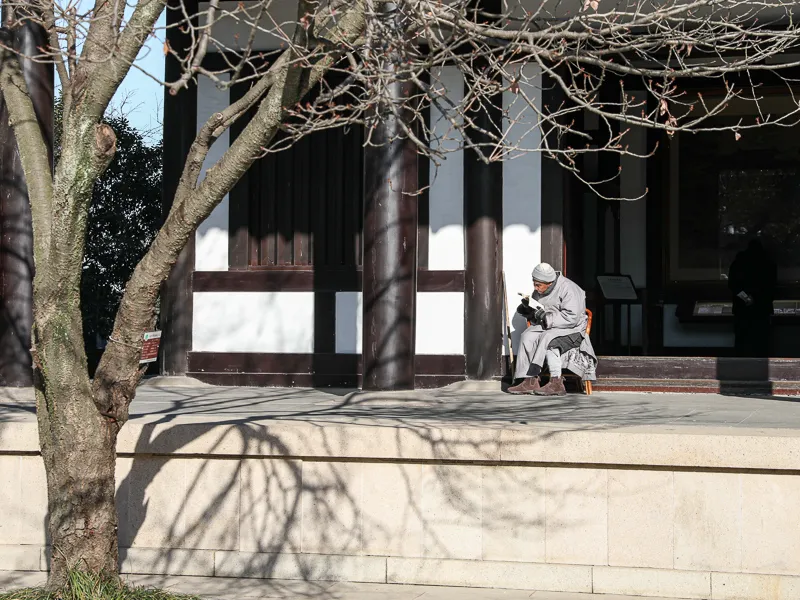
An elderly monk reading carefully in front of the Jianzhen Memorial Hall
Canon EOS 5D Mark IV
EF 24-70 f/2.8L II USM
F8.0 | 1/160 s | 70mm | ISO 100
Jianzhen brought more than Buddhist precepts to Japan. He also brought advanced Tang knowledge of medicine, architecture and calligraphy. In Buddhism, as a senior monk of the Vinaya school, he established a formal system of monastic discipline in Japan. In architecture, he worked with his disciples and craftsmen to build the famous Tōshōdai-ji in the style of the High Tang period. Tōshōdai-ji is now designated a National Treasure of Japan and forms part of a World Heritage Site. In calligraphy, Jianzhen brought authentic works by Wang Xizhi and Wang Xianzhi, as well as other calligraphic texts, which had a strong influence on the development of Japanese calligraphy. Jianzhen himself was also an accomplished calligrapher. His work Request for Sutras is preserved at Tōshōdai-ji and is designated a National Treasure of Japan.
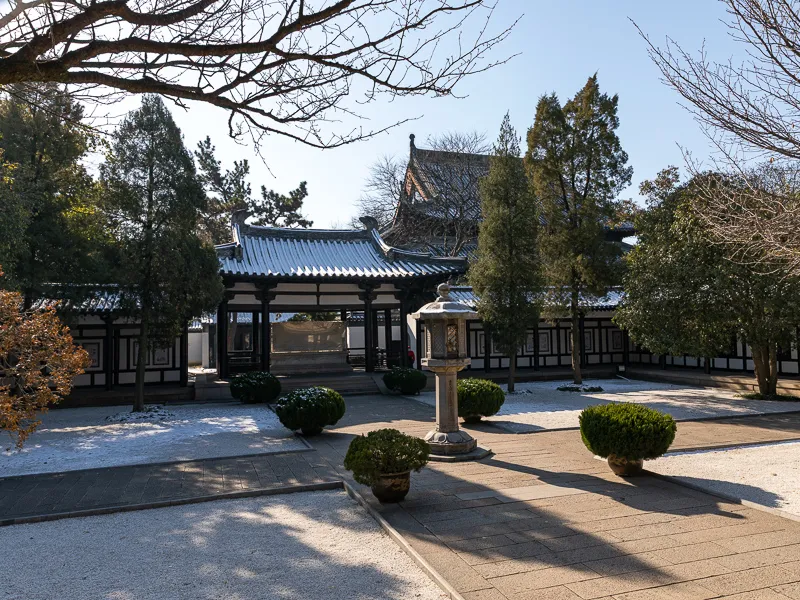
The stone lantern in the center of the memorial courtyard symbolises friendship between China and Japan
Canon EOS 5D Mark IV
EF 24-70 f/2.8L II USM
F8.0 | 1/250 s | 24mm | ISO 100
In 763, Jianzhen died at Tōshōdai-ji. Before his death, his disciples made a dry-lacquer statue based on his seated appearance. This statue, now regarded as a national treasure, has remained at Tōshōdai-ji for more than a thousand years.
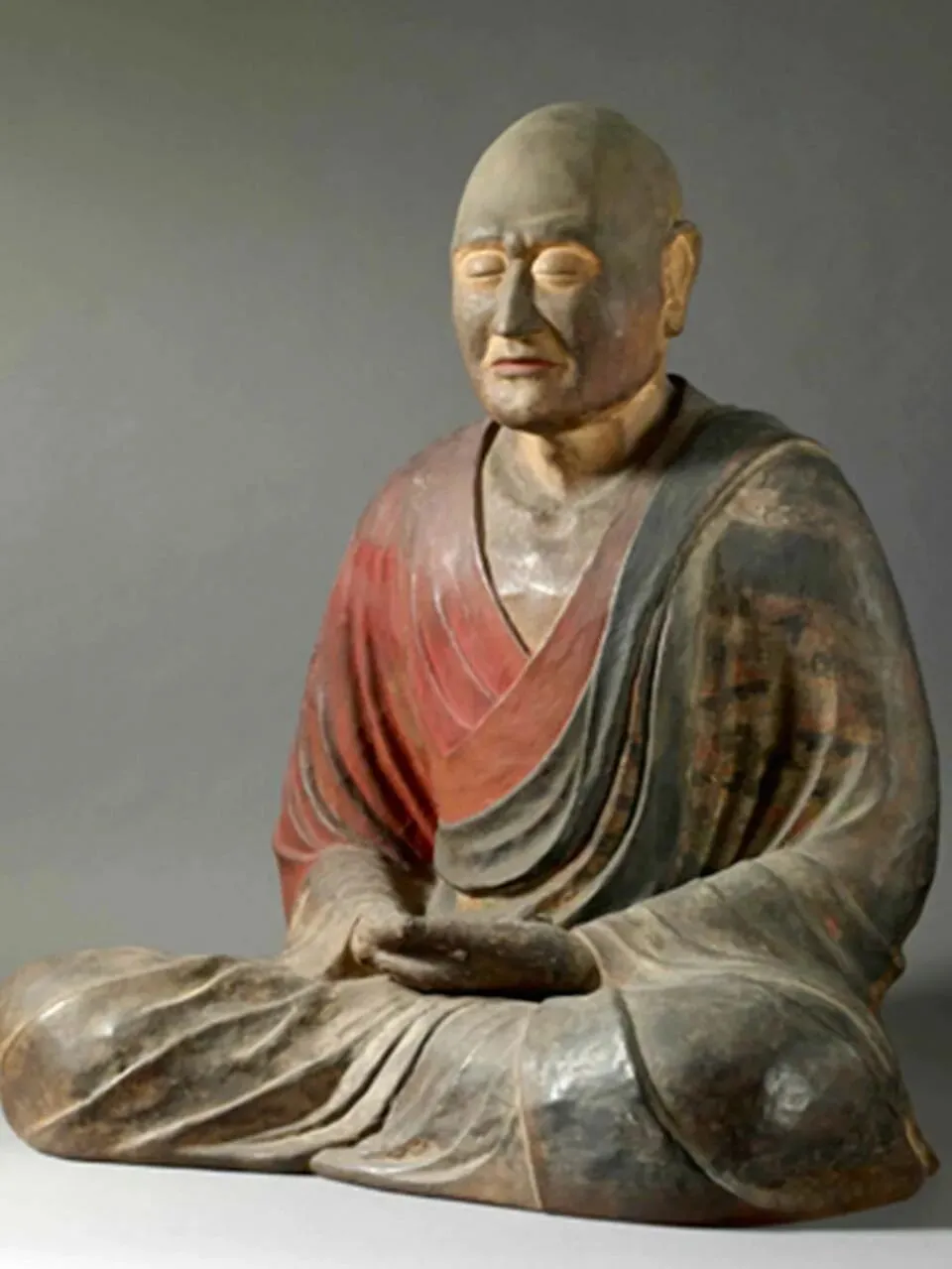
Dry-lacquer statue of Jianzhen, a National Treasure of Japan, kept at Tōshōdai-ji in Nara
Image from the official Tōshōdai-ji website
https://www.toshodaiji.jp/ganjin.html
After Jianzhen left for Japan, he spent the rest of his life there spreading Buddhism and never returned to his homeland. Because of this, Elder Morimoto, abbot of Tōshōdai-ji, had long hoped to “bring Jianzhen back home”, but the wish remained unrealised for many years. In 1978, during Deng Xiaoping’s visit to Japan, Morimoto raised the idea again and received a positive response. In 1980, Elder Morimoto Kōjun of Tōshōdai-ji accompanied Jianzhen’s lacquer statue back to Yangzhou. After more than twelve hundred years away, Jianzhen returned once again to his hometown.
Other Places in the Temple
Pingshan Hall, within Xianren Jiuguan (“Former Residence of the Immortal”), was built by Ouyang Xiu in the eighth year of the Qingli era while he was prefect of Yangzhou. It stands to the west of Daming Temple. Pingshan Hall is an open hall with a single-eaved gabled roof and covered gallery, five bays wide and three bays deep. In front of the hall is a terrace ending in a stone railing. Beyond it, old trees follow the slope downward in dense green layers. Su Shi, a student of Ouyang Xiu, was transferred from his post as prefect of Xuzhou to prefect of Huzhou in the second year of the Yuanfeng era. Passing through Yangzhou, he climbed Pingshan Hall and remembered his late teacher Ouyang Xiu, writing Xijiang Yue · Pingshan Hall:
Three times I have passed beneath Pingshan Hall,
Half a lifetime gone in the snap of a finger.
Ten years since I last saw the old immortal,
His vigorous calligraphy still flies across the wall.
I came to mourn the prefect of letters,
And sing again of willows in the spring wind.
Do not say that all things vanish in an instant,
Before they vanish, they are already dreams.
West of Pingshan Hall is Xiyuan Fangpu, also known as Yuyuan Fangpu, built during the Yongzheng era of the Qing dynasty. Unfortunately, the garden was destroyed during the wars of the Xianfeng era. Although it was later repaired, its decline could not be completely hidden. After the founding of the People’s Republic of China, it underwent three further restorations and gradually recovered some of its former appearance. Covering several dozen mu, the garden has ponds, rockeries, pavilions and waterside buildings arranged around one another. In winter, a thin layer of ice on the ponds and the sparse trees give Daming Temple a more subdued appearance, while the small number of visitors adds to the quiet.
The stone path in front of Ouyang Shrine
Canon EOS 5D Mark IV
EF 24-70 f/2.8L II USM
F8.0 | 1/25 s | 53mm | ISO 100
Many inscriptions, stone carvings and buildings are scattered throughout the gardens. Among them is a well known as the “Fifth Spring”. Its name comes from Notes on Water for Brewing Tea:
The late Vice Minister of Justice, Bozhou, was an elder relative of Yu Xin. Learned and widely read, with a keen ability to judge character, he ranked seven kinds of water according to their suitability for tea: Nanling water of the Yangtze River first; the stone spring at Huishan Temple in Wuxi second; water from Tiger Hill Temple in Suzhou third; water from Guanyin Temple in Danyang fourth; water from Daming Temple in Yangzhou fifth; water from the Wusong River sixth; and Huai River water last, in seventh place.
The spring at Daming Temple thus became known as the Fifth Spring.
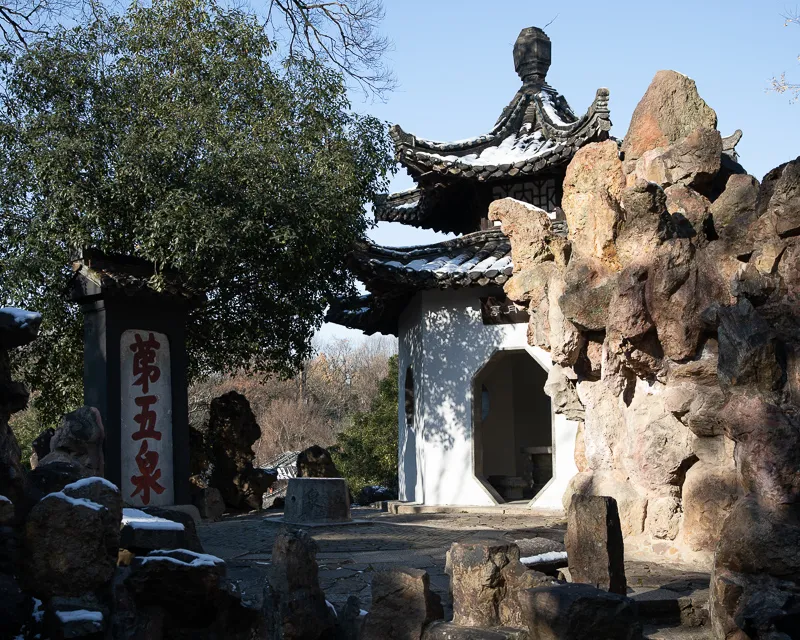
The Fifth Spring
Canon EOS 5D Mark IV
EF 24-70 f/2.8L II USM
F3.5 | 1/640 s | 35mm | ISO 100
North of Daming Temple is the Jianzhen Library, a Tang-style building completed in 2005. Although it cannot be entered directly from Daming Temple, the building can be seen from the temple grounds. It is a specialist Buddhist library, and its collection ranks among the leading collections of its kind in China. Unfortunately, there was no time to visit the library separately on this trip.